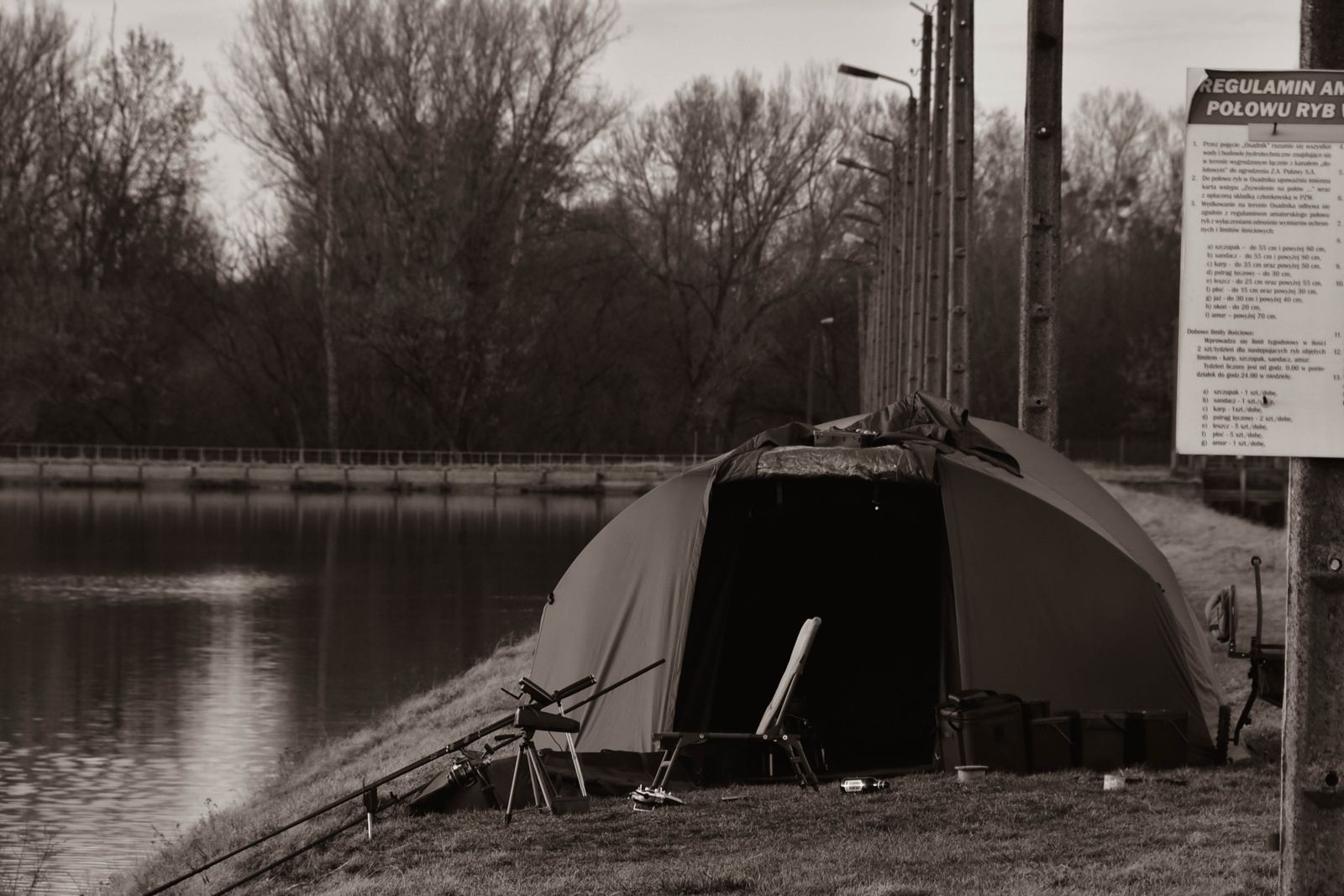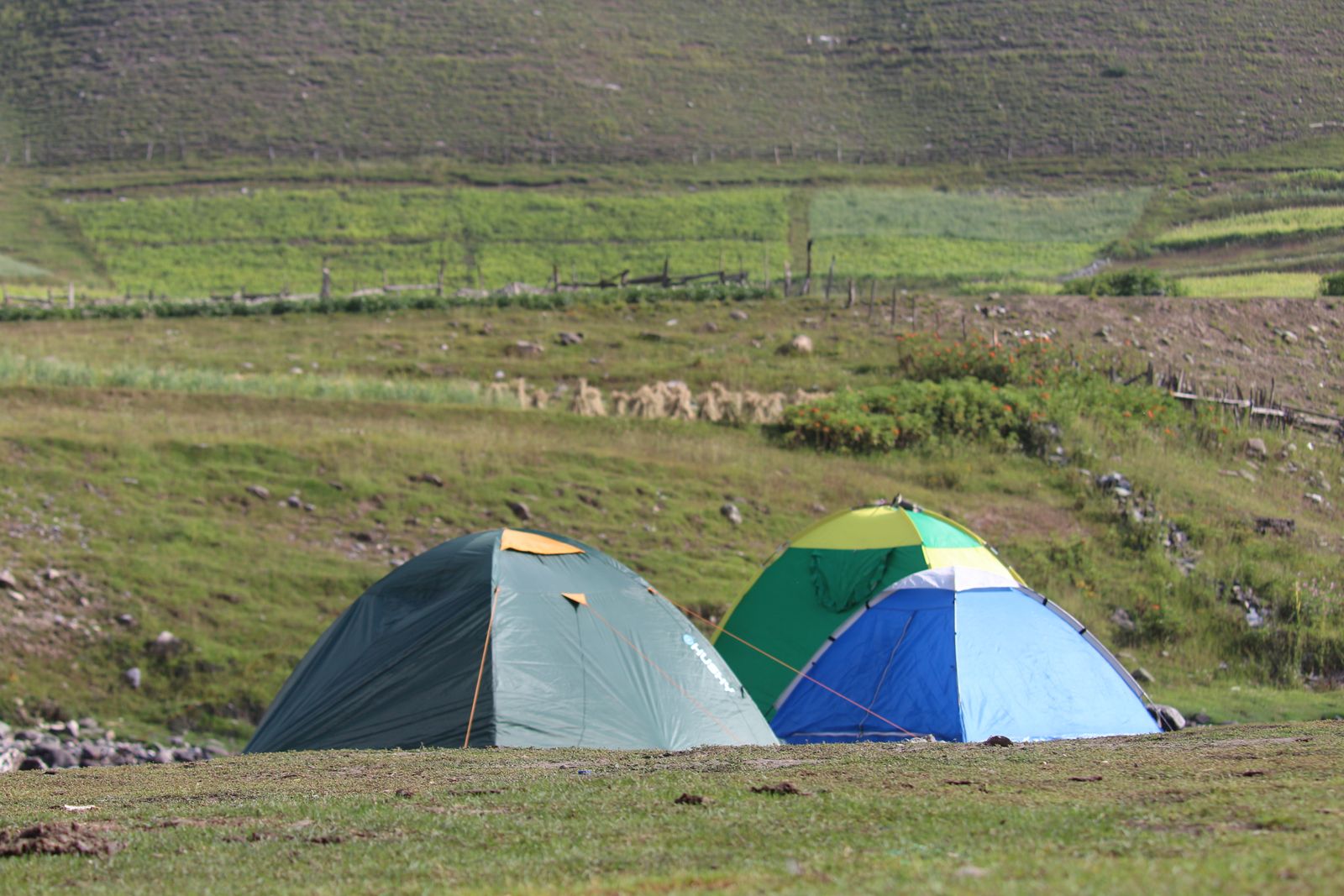
Most tents stand on bendy, jointed poles; big tents on a rigid frame; air tents on tubes pumped up with air; and some of the lightest on the walking poles you carry anyway. What holds a tent up decides how much it weighs, how it copes with wind, how fast it goes up and what you do when something breaks. This guide takes each kind in turn, explains how to mend it, and ends with which frame suits which kind of trip.
Every tent in the shop is also filed by the frame its maker names, in Tents by Poles. Some tents mix materials, such as steel poles with fibreglass rods, so they appear in more than one of those ranges.
What the poles do
Poles do three jobs at once. They hold the fabric up in the shape the tent was designed for, so there is headroom where you sit and space where you sleep. They hold the fabric tight, which matters more than it sounds: a taut flysheet sheds rain and stays off the inner tent, while a slack one flaps in the wind, collects puddles and touches the inner, which lets water through. And they carry the push of the wind down to the pegs and guy lines, which is why a tent with every guy line pegged out is far stronger than one pitched loosely.
Freestanding and not freestanding
How the poles are arranged changes how a tent goes up. On a dome tent the poles cross over the top, so most dome tents stand up on their own before a single peg goes in, and you can pick one up and move it. A tunnel tent has hoops in a row, which gives more room for the weight but means it only stands once it is pegged out at both ends. Tipi and pyramid tents stand on one tall pole in the middle and hang from it, so the pegs round the edge hold the whole shape: peg them out fully and evenly, or the pole leans.
How a folding pole is made
A folding tent pole is a row of short sections joined end to end. An elastic cord, called shock cord, runs through the middle of them all and pulls each section into the next, so the pole snaps together in your hands and folds into a bundle for the bag. The joints matter most. Push every one fully home before you bend the pole into place, because a joint that is only half seated is where poles split. When you take the tent down, fold the pole from the middle outwards so the elastic wears evenly, rather than pulling the sections apart from one end.
Tents with no poles of their own
Some ultralight tents and shelters come with no poles at all. They are pitched on trekking poles, or on one support pole you buy separately, which saves carrying a second set of poles on a walking trip. One 15D silicone-coated single-person tent here weighs about 800g because of it. The pyramid tarp tent in the shop stands on a single centre pole or two trekking poles joined together, and each size says how long a pole it needs: the smallest, H170, needs a 1.7m pole. A single-layer pyramid tent here takes one 135cm trekking pole or two 160cm poles. Check your own poles reach before you buy one. See pyramid tents.
Fibreglass
Fibreglass poles are made of glass fibres set in resin. Makers also call it glass fibre or FRP, short for fibre-reinforced plastic, and some descriptions say "glass steel", which is another name for the same thing: one pop-up beach tent in the shop has a "glass steel frame", and its poles are fibreglass, not steel. It is the cheapest pole material.
What fibreglass is good at
Fibreglass flexes a long way, which is why it suits pop-up and automatic tents that spring open on their own from a folded frame. It is cheap, so it keeps those tents affordable, and a broken section is cheap and easy to replace. For a tent that goes in the car to a summer campsite, a festival or the beach, it does the job well. The fibreglass tents in the shop include pop-up and automatic family tents, beach and sun shelters, single-layer camping tents, truck bed and SUV rear tents, motorbike garages and a clear dome. See fibreglass pole tents and pop-up tents.
Where fibreglass lets you down
For the same strength, fibreglass is heavier than aluminium, so it is a poor choice for a tent you carry far. And it fails in a different way. Aluminium bends under too much load and can usually be splinted and used until you get home; fibreglass bends a long way and then cracks or splinters. Cold makes it worse, because fibreglass gets more brittle as the temperature drops, so a gust or a rough fold that it would take in July can crack it on a frosty morning. Bend fibreglass poles gently into place, never force a section into a sleeve, and peg out every guy line so that the fabric, not the pole, takes the wind. A cracked section can leave sharp glass splinters, so handle a break with gloves on if you have them.
Thickness
The pole's diameter is the number to look for. In the shop it runs from 7mm on a light 2-person beach tent, which weighs about 925g in all, through 7.9mm on many camping and vehicle tents, and 8.5mm on an SUV rear tent, to a 10mm frame on a clear bubble tent. A thicker pole is stiffer and heavier. Some frames mix materials: one large awning tent here pairs an 8mm aluminium pole with a 9.5mm fibreglass pole.
Aluminium and aluminium alloy
Aluminium is the strongest pole for its weight, which is why it is on most tents you carry and most tents made for wind and winter. Under a heavy load it bends before it breaks. A bent aluminium pole can usually be straightened a little, splinted with a repair sleeve and used for the rest of the trip, where a broken fibreglass pole often cannot. It also keeps its strength in the cold. An old aluminium pole may keep a slight curve when it is not pitched; that is normal.
Every aluminium pole is an alloy
Pure aluminium is too soft to make a pole. Tent poles are made of an alloy: aluminium mixed with small amounts of other metals, such as zinc, which makes it strong enough to bend into a hoop and spring back. So "aluminium poles" and "aluminium alloy poles" are the same thing described two ways. The shop keeps two ranges because makers use both words: aluminium pole tents holds every tent on aluminium, and aluminium alloy pole tents the ones whose makers use the word alloy, so most tents are in both.
7001, 7075 and 6061
A number such as 7001 names the alloy. These are the three you will see:
- 7001 is the alloy most tents in the shop name. It is made for poles that must bend and recover. The TAIJI2 2-person tent weighs 1,800g for its inner tent, flysheet and 7001 poles together.
- 7075 is generally rated stronger still. In this shop it turns up mostly in pegs: one backpacking tent comes with three-sided 7075 aluminium stakes.
- 6061 is a general-purpose alloy, cheaper and common on budget gear and on big frames.
The number tells you the metal, not the size, so read the pole's diameter as well where the maker gives it.
Diameter and what it tells you
A thicker pole is stiffer and heavier. The two-person backpacking tents here mostly use 7.9mm or 8.5mm poles: the Archeos 3P runs on 7.9mm 7001 poles and weighs 3.5kg as a 3-season tent or 3.9kg with its 4-season inner. A solo hot tent here has 10.2mm poles for harsh weather. Big frames go much thicker: a 5 to 8 person family tent with two bedrooms stands on 16mm aluminium rods with 22mm iron brackets, and a 4x4 side awning on aluminium sections of 19mm, 22mm and 25mm. Tipi hot tents stand on one aluminium alloy centre pole; the 500PRO tipi is 500cm across and 240cm high. For a tent you carry, thin poles save weight; for a tent that faces snow or strong wind, thicker poles keep their shape. See backpacking and trekking tents and 4-season tents.
Steel and iron frames
Steel and iron are the heaviest and stiffest frames in the shop. They are used where weight does not matter and stiffness does: big tents, yurts and cabins that are pitched once and left standing, car tents, and a few pop-up shelters. Steel is iron with a little carbon added, which makes it stronger, but the shop follows the maker's own word, so a frame called steel is in steel frame tents and one called iron in iron frame tents.
Steel
Steel turns up in two quite different ways. The first is the solid frame of a big tent: a canvas-style Oxford yurt for 4 to 5 people on a steel pole frame, a glamping pod cabin built on a steel frame to stand semi-permanently, a wedge hard-shell roof tent with a steel frame and gas-assisted opening, and an SUV tailgate tent held out on two 1.9m steel poles. A frame like that does not flex in wind, which makes a big tent feel solid, but it is heavy and needs two people to put up.
The second is spring steel: wire or brackets inside pop-up shelters that twist flat into a disc and spring open in seconds. The pop-up ice fishing tents here are 150 by 150 by 190cm when open, fold to 62 by 62 by 5cm and weigh about 3kg. A spring steel frame opens with real force, so point it away from your face and from other people when you let it go, and practise folding it back at home once or twice before you need to do it on a windy beach.
Iron
Iron frames in the shop are iron pipe, bars or brackets. The Luxury Bell Tent Yurt stands on a galvanised iron pipe frame. The Naturehike Village 13 family tent uses three 190cm iron support bars and weighs about 23.8kg in all. Two beach sun shades stand on anti-rust iron poles and are anchored by filling pockets with sand instead of pegging; one weighs 1.6kg. In other tents iron works alongside lighter poles, such as a 3 to 4 person tent on an iron rod and fibreglass poles, or a car side awning bracketed in aluminium alloy and iron. Where makers mix metals, iron usually goes where the load gathers, at the brackets and upright bars, while the lighter poles do the bending.
Rust
Steel and iron rust where their coating is broken. Galvanised iron is coated in zinc, which slows rust, and other frames are painted or powder-coated, but chips, cut ends and threads are where rust starts. Dry the frame before you store it, keep the sections in their bag so they do not knock each other, and look over the joints at the start of each season.
Air beams
An air tent has no poles. Tubes sewn into the tent, called air beams, air poles or air columns, are pumped up, and once they are firm they hold the tent up. You peg the tent out flat, connect the pump, and the tent rises into shape. There is nothing to thread or snap, so even a big family tent goes up quickly, and taking it down is a matter of opening the valves. See air beam tents and inflatable air tents.
What the beams are made of
Many of the air beams in the shop are PVC tubes, often inside a fabric sleeve that takes the wear. The Naturehike Village 6 stands on PVC air columns 12cm across, and an inflatable roof tent on 11cm columns. On many air tents each beam has its own valve and is pumped up on its own, so a leak in one leaves the others standing; some big tents fill several beams from one point.
Pumps and pressure
Check what pump comes with the tent before you buy. Most air tents here come with a hand pump, one with an electric pump, and on one large tent the pump is an optional extra. Use a pump with a gauge and fill each beam to the pressure the maker gives, which on most air tents is around 5 to 7 psi. Do not pump until a beam feels rock hard, because a beam over its pressure can burst at a seam. Air expands in the sun and shrinks in the cold, so a tent pitched on a cold evening may need a few pumps the next morning, and one pitched in the midday heat can be let down a little.
Weight
Air beams weigh more than poles. The 4 to 5 person air dome here, 220 by 220cm and 170cm high, weighs about 7kg. A four-season cotton air tent with one bedroom weighs 29.5kg, and the largest inflatable cabin here, 420 by 513cm and 330cm high for 8 to 10 people, weighs 95kg. These are tents for the car and a pitch you can drive close to.
Mending or replacing a pole
A broken pole does not mean a new tent: splint it on the spot, then mend it properly at home.
On the campsite: the repair sleeve
A repair sleeve is a short metal tube a little wider than the pole. Slide it along the pole until it is centred over the break or the bend, then tape both ends of it to the pole. Some tents in the shop come with one, such as the Taiji 2-person tent, and one backpacking tent comes with a pole repair kit; if yours did not, a sleeve weighs almost nothing and is worth carrying. With no sleeve, a tent peg taped along the break will do as a splint for a night or two. Either way, it is a repair to get you home.
At home: a new section or a new pole
The lasting fix is a new section or a whole new pole of the same size. Two measurements matter: the outer diameter of one section, and the full length with every section joined. The tent poles range has replacement poles from about 7.9mm to 11mm across and from 3.2m to 5.2m long, and shock-corded 7001 alloy poles at 360cm and 430cm, measured with their end tips. Several are sold to replace a snapped or worn fibreglass pole, and an aluminium pole will fit a tent that had fibreglass ones if the diameter and length match. Some can be shortened by taking out a section or cutting with a pipe cutter, but take care not to cut the elastic cord inside.
Tired elastic
Over the years the shock cord inside a pole loses its stretch, and the sections stop pulling together. It can be replaced: untie the cord at one end, thread new cord through the sections in the same order they came off, pull it to a little tension and tie it off again.
A leaking air beam
If a beam goes soft, look at the valve first. A valve not screwed fully home, or with grit in it, is the most common cause of a slow leak. If it still loses air, take the tube out of its sleeve, pump it up and brush on soapy water: bubbles show the hole. Patch it with a repair made for PVC or TPU, let it set, test it again with soapy water and put it back with the valve in its socket. The tent repair kits range has clear TPU patches and tapes sold for inflatables. A leak along a welded seam of the tube cannot usually be patched, and the lasting fix is a replacement beam from the tent's maker.
Which poles suit which tent
Start from how the tent travels and when you will use it.
- Carrying on your back. The usual frame: aluminium alloy, or your walking poles. Why: strongest for the weight; bends rather than snaps.
- Winter, the hills and strong wind. The usual frame: thicker aluminium, or one stout centre pole on a tipi. Why: keeps its strength in the cold, where fibreglass gets brittle.
- A summer campsite, a festival or the beach. The usual frame: fibreglass, or a spring steel pop-up. Why: cheap, flexible and quick; weight does not matter in the car.
- A family week in one place. The usual frame: steel, iron, aluminium rods or air beams. Why: stiff and steady; air beams pitch quickest.
- Glamping and long stays. The usual frame: steel or galvanised iron frames, or a bell tent's centre pole. Why: built to stand for weeks; weight is no concern.
- A car roof or side awning. The usual frame: aluminium, steel or air. Why: the vehicle carries the weight.
The fabric over the poles matters as much as the frame, and the two are chosen together: a light nylon flysheet on thin alloy poles, a heavy canvas wall on a steel frame. The guide to tent fabrics goes through each one. If you are still deciding between styles, how to choose a tent starts from who is sleeping in it and how you will get there.
Questions people ask
Are aluminium poles worth having over fibreglass?
For a tent you carry, or one you use in wind, cold or the hills, yes: lighter for the same strength, better in the cold, and more likely to bend than snap. For a car-camping tent used in summer, fibreglass does the job for less money, and a broken section is cheap to replace.
Can I put aluminium poles in a tent that came with fibreglass?
Yes, if the diameter and the full length match the pole you are replacing. Measure a section of the old pole across, and the whole pole with every section joined, and choose the same.
What about carbon fibre poles?
Carbon fibre is the lightest pole material of all and is found on some very light tents, but it is stiff and more likely to snap than bend. None of the tents in this shop is sold on carbon fibre poles; the only carbon fibre here is in the shells of two hard-shell roof tents.
Why is one tent in two or three pole ranges?
Because its frame mixes materials, such as steel poles and fibreglass rods, or an aluminium frame with iron brackets, and it is filed under each material its maker names. A tent on aluminium alloy is in both aluminium ranges.
Where to go next
- Tents by poles: every tent sorted by its frame.
- Aluminium pole tents and fibreglass pole tents, the two most common frames.
- Tent poles and tent repair kits for spares and mending.
- Single, double and triple layer tents, on how the fabric over the frame is put together.
- Tent waterproof ratings explained, on the millimetre figures in the descriptions.