Tents are described by how many layers stand between you and the weather: single layer, double layer, and in a few winter tents triple layer. The number tells you a lot about how a tent behaves on a cold, still night, how much it weighs, how warm it is and how quickly it goes up. It also explains most of the water people find inside a tent in the morning, which is usually not rain at all. This guide explains what each kind is, who it suits, and what you gain and give up with each layer. For the waterproof figures on the fabric itself, see tent waterproof ratings explained.
What a layer is
A layer is a skin of fabric that covers the whole of the tent you sleep in. It is not the groundsheet, which every tent has, and it is not a mesh window or a door panel. Count the skins between your head and the sky.
- A single-layer tent is one waterproof skin. The same fabric keeps the rain out and holds the warmth in, and you sleep directly under it.
- A double-layer tent has a waterproof flysheet over a separate inner tent. The inner is where you sleep. It is breathable, often partly or mostly mesh, and there is a gap of air between it and the flysheet.
- A triple-layer tent adds an insulating layer for the cold. In this shop the tents in that range are thickened or padded cotton winter tents, made for ice fishing and the coldest days.
This shop files each tent into the tents by layers ranges by its own description. A tent goes in single layer tents when it says single layer, single wall or single skin. It goes in double layer tents when it says double layer, or mentions an inner tent, a flysheet or a rainfly. It goes in triple layer tents when it says its walls are three layers or thickened cotton. Some tents are filed in both single and double layer, because they are sold either way. The Single Layer Pyramid Camping Tent, for example, is sold as the flysheet alone or with an inner tent, and the Pop Up Tent 4-6 Person Automatic comes in a single-layer and a double-layer version. Read the product page to see which you are buying.
Makers use several words for the same parts, which can make product pages harder to compare. The flysheet is also called the fly, the rainfly, the outer tent or the outer. The inner tent is also called the inner or the tent body, and a single-layer tent is sometimes called single wall or single skin. A "double-layer door" or a "three-layer finish" is a detail of one part, not a layer of the whole tent, so it does not count.
Single layer: who it suits, and condensation
A single-layer tent has one thing to pitch, so it goes up quickly, and with no inner tent it weighs less and packs smaller than a double-layer tent built the same way. That suits a few kinds of trip very well:
- Walkers counting grams. The Single Person Waterproof Tent here weighs about 818g, and the Ultralight Camping Tent 1000g in its one-person size and 1200g for two.
- Summer, the beach and festivals. Many pop-up tents and beach shelters are single layer, which is why they open so fast. Most of the summer tents here are single layer.
- Shelters that stand on one pole. Pyramid and tipi tents are often a single skin with an inner tent to add if you want one. See pyramid tents.
- Storage and vehicle covers, such as the motorbike storage tents, where nobody sleeps inside.
The cost is condensation. Every night you breathe out moisture, and a little more comes off your skin, your clothes and anything wet you bring in. Which?, which tests tents, puts it at up to a pint of water a night for one person. That moisture settles on the coldest surface it meets. In a single-layer tent that surface is the one skin you are sleeping under, so on a cold, still night the inside of the walls gets wet and drips, and brushes off on your sleeping bag when you touch it. It is not a leak, though it can feel like one.
Most single-layer tents are a coated fabric that does not let water vapour through. Some costly mountain tents are made of a waterproof-breathable fabric instead, which lets some of it out, but no single skin gets rid of it all. What helps:
- open the vents, and on a dry night a door, so damp air can get out;
- pitch where a breeze reaches the tent, not in a hollow or right beside water, where cold, damp air settles;
- keep wet coats and boots outside, and never cook inside;
- keep yourself and your kit off the walls, and wipe the inside down with a small towel before you pack.
On a warm, breezy night the difference between one layer and two hardly shows. On a cold, still night in spring or autumn it shows a great deal. The single-layer pyramid tent here has two adjustable vents with mesh and breathable cloth layers, which its maker says reduce condensation, and that kind of detail is worth looking for on any single-layer tent.
A single layer has one more thing in its favour: in the rain, it is dry inside the moment it is up, because there is no inner tent to get wet while you pitch. With no inner, there is also usually no porch in the usual sense, so boots and bags share your space or stay outside under a small awning. If you want somewhere to sit out a wet evening, a single-layer tent is a tight fit.
Double layer: flysheet and inner, and the air gap between them
A double-layer tent splits the work between two skins. The flysheet is waterproof and takes the rain and wind. The inner tent is breathable, and it is where you sleep. Moisture from your breath passes through the inner into the gap and settles on the inside of the flysheet, then runs down to the ground outside the inner. The condensation still forms; it just forms on a surface you are not lying under. That is why a double layer is the safer choice for most of the year in Britain, and why most tents are built this way.
The gap between the two skins does three more things.
- It holds a layer of air. Air between two skins slows the warmth leaving the tent, so a double-layer tent is warmer than a single skin of the same fabric.
- It keeps drips off you. If the flysheet is pressed in by wind or a heavy shower, it touches air, not your sleeping bag. Pitch the flysheet taut so it does not touch the inner: where they touch, water can pass from one to the other.
- It makes the porch. The flysheet usually reaches past the inner door, and the covered space between them is where boots, bags and wet coats go.
Mesh inner or solid inner
The inner tent decides how a double-layer tent feels. A mesh inner lets air straight through, so it is cool on a summer night and keeps insects out. A solid inner of nylon or polyester keeps draughts off and holds more warmth, which is what you want from autumn to spring. Several tents here are sold with a choice. The TAIJI2 2-person tent comes with a 3-season inner of 20D net yarn, which weighs 512g, or a 4-season inner of 210T nylon. The Taiji 1 offers a mesh inner for three seasons or a 15D nylon inner for four. The Archeos 3P uses B3 mesh and 190T polyester together.
Pitching in the rain
Ask how a double-layer tent goes up. Some pitch the flysheet first, or both layers together with the inner already clipped in, so the inner stays dry while you pitch in the rain. Others pitch the inner first and throw the flysheet over it, which is fine on a dry evening and less so in a downpour. Some let you pitch the inner on its own on a dry night as a cool, bug-proof shelter; on others the inner hangs from the flysheet and cannot stand alone. The product page or the maker's instructions will say.
Keeping the gap working
The air gap only does its job if air can move through it. Most double-layer tents have vents high in the flysheet, and many let you raise the bottom edge of the flysheet off the ground on a warm night or pull it down tight in the cold. Open the high vents every night, even in rain: warm, damp air rises and leaves through them, and cooler air comes in low down. Shutting everything to stay warm traps the moisture inside and makes the flysheet streaming wet by morning. On a winter tent with a snow skirt, the skirt seals the bottom edge against wind and snow, so the high vents matter even more.
Double layer tents here run from ultralight backpacking tents to two-room family tents and hot tents, and of the 4-season tents here that say how they are built, most are double layer. If you are not sure which to buy, buy double layer. It is the most forgiving in British weather.
Triple layer and cotton-padded tents for winter and the ice
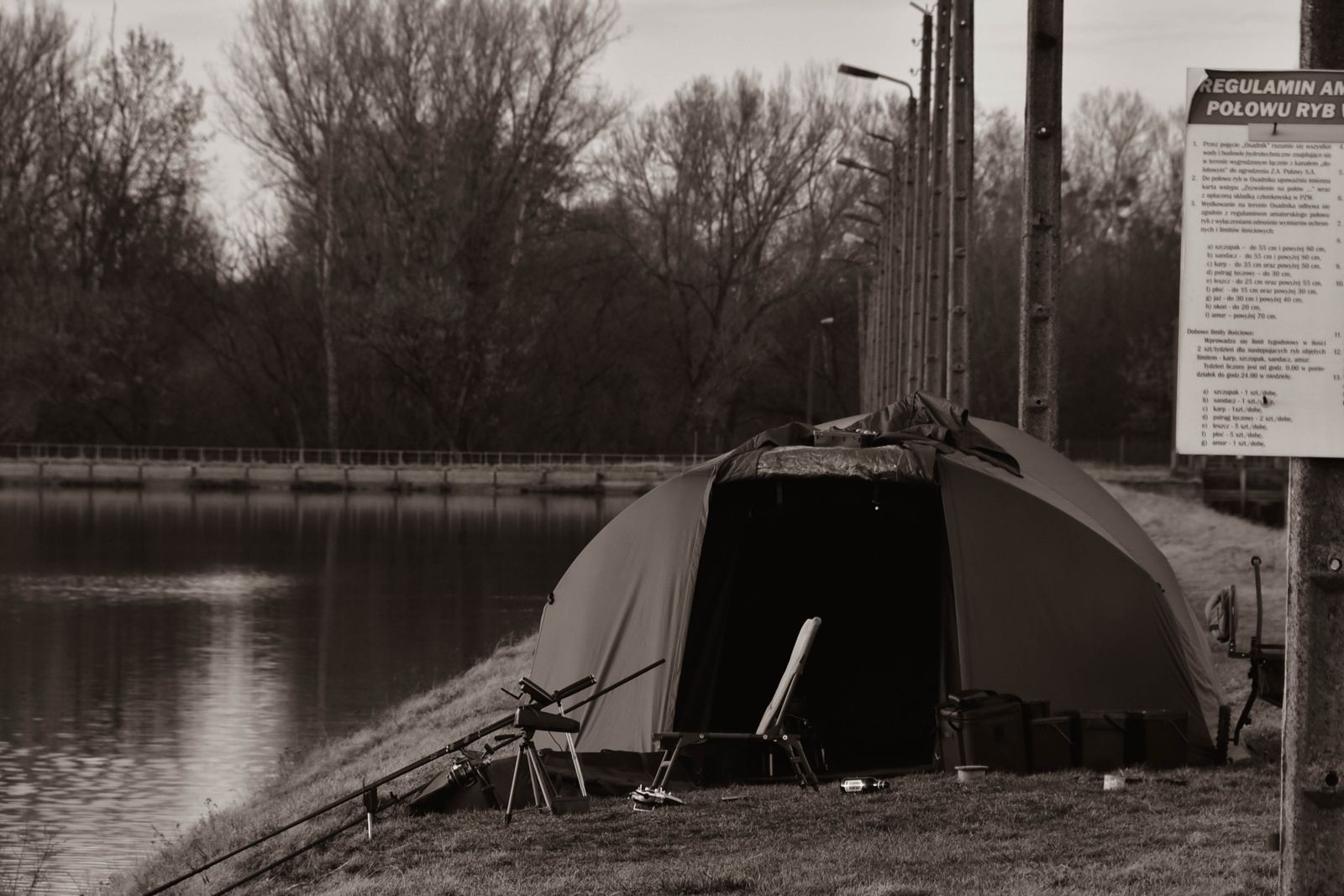
A triple-layer tent adds insulation to the tent's walls, to hold heat in for hours in one place on a freezing day. They are built for people who sit still in the cold, above all anglers fishing through a hole in the ice or from a winter bank, rather than for walkers. Every tent in the triple layer range here is a thickened or padded cotton winter tent.
- The Thickened Cotton Winter Ice Fishing Tent goes furthest: its maker describes five layers of cotton and 210D Oxford cloth. It is 220 by 220cm and 165cm high, opens quickly on fibreglass poles, and comes with four ice nails and four wind ropes, because ordinary pegs will not go into ice.
- The Single Winter Fishing Cotton Tent is a one-person cotton shelter in sizes from 1.8m square and 1.5m high to 2.4m square and 1.8m high.
- The Chimney Winter Fishing Tent is thickened cotton with flame-retardant Oxford fabric, for three or four people, with a chimney opening for a stove.
- The Large Hexagonal Cotton-Padded Winter Tent has room for more than one person and their kit.
These and the other closed-in cold-weather shelters are in ice fishing tents, and the wider range for cold, wind and snow is winter and snow tents. Not every warm fishing shelter is padded: the Thickened Winter Fishing Tent here is a double layer of coated polyester, and the pop-up ice fishing tent for one or two is a single layer of silver-coated polyester. Those are lighter, and less warm.
What padding does not do
Padding keeps the warmth in. It does not make a tent more waterproof. The Chimney Winter Fishing Tent is rated 1,000mm to 1,500mm, which is fine in dry, cold weather and less so in a long wet spell. Thick cotton also takes a long time to dry, so a padded tent must be dried right through at home before it is stored, or it will go mouldy. And a tent built to hold heat is hot and stuffy in summer.
Stoves and carbon monoxide
Nobody should heat a tent with a barbecue, a camping stove or a heater. They give off carbon monoxide, which has no smell and kills, and a charcoal barbecue that has gone out still gives it off, so it never goes inside a tent or into a porch. The only tent that takes a stove is a hot tent made for one, with a stove jack, the fire-resistant ring the chimney pipe passes through, used as the maker intends. Use the kind of stove made for that tent, keep a carbon monoxide alarm inside, keep a vent open whenever it is lit, and keep bedding and the inner tent well clear of it. See hot tents with a stove jack.
Layers against weight and warmth
Each layer adds warmth and adds weight, but the number of layers is only part of the story. How a tent is made, the fabric and the poles, matters as much. The figures the makers give on some of the tents here show both sides:
- Naturehike Star Trails EXT, 1 person. Layers: double. Weight the maker gives: about 0.78kg minimum.
- Single Person Waterproof Tent. Layers: single. Weight the maker gives: about 818g.
- Ultralight Camping Tent, 1 person. Layers: single. Weight the maker gives: 1000g.
- Single Layer Pyramid Camping Tent. Layers: single, inner extra. Weight the maker gives: flysheet 454g, 1-person inner 433g.
- 2 Person Ultralight Silnylon Tent. Layers: double. Weight the maker gives: flysheet 580g, inner 560g (3-season) or 670g (4-season).
- Pop Up Tent 4-6 Person Automatic. Layers: single or double. Weight the maker gives: 4.2kg single, 5.6kg double (the double is also larger).
- Thickened Winter Fishing Tent. Layers: double. Weight the maker gives: 2.2kg.
- Thickened Cotton Winter Ice Fishing Tent. Layers: five layers. Weight the maker gives: about 13kg.
Three things stand out. First, the lightest double-layer tents here are lighter than several single-layer ones, because they are made of very thin nylon. A single layer saves weight only against a tent built the same way. Second, an inner tent on a light tent adds roughly what the flysheet weighs, around half a kilo for one or two people on the tents above, and a solid inner weighs a little more than a mesh one. Third, padding is what makes a tent heavy: the five-layer cotton ice fishing tent weighs about six times as much as the one-person double-layer fishing shelter, though it is also bigger, and it is made to go in the car and be carried a short way to the water.
For warmth, the order runs the other way. A single skin is the coolest and the least sheltered from draughts. A double layer with a solid inner holds noticeably more warmth and keeps the condensation off you. A padded triple layer holds the most, but only while you are inside it with the door shut. Your sleeping bag and mat still do most of the work of keeping you warm at night, whichever tent you choose.
So choose by the trip. Carrying it far in summer: single layer, or a very light double. Camping most of the year in Britain, on foot or by car: double layer, with a mesh inner for summer and a solid one for the colder months. Sitting out a winter day by the water: triple layer, if the car is close. For more on the seasons, see 3-season tents and 4-season tents.
Questions people ask
Does a double layer stop condensation?
No, it moves it. Water still forms on the inside of the flysheet on a cold night, but the inner tent keeps it off you and your sleeping bag. Open the vents and keep the flysheet taut so it does not touch the inner.
Is a single-layer tent waterproof?
It can be just as waterproof as a double-layer tent, because it is the same kind of coated fabric. The difference is condensation, not rain. Check the rating on each one, as with any tent.
Can I use a single-layer tent in winter?
A few are made for it, such as the single-layer tipi hot tent here, which takes a stove through its stove jack. For most winter camping a double-layer 4-season tent with a solid inner is warmer and drier.
Is a triple-layer tent any good for camping in summer?
No. It is built to hold heat in, so in warm weather it gets hot and stuffy, and it is heavy to carry. For summer see summer tents.
Can I add an inner tent to a single-layer tent later?
Only if the maker sells one for it. Several pyramid tents here are sold as the flysheet alone or with an inner, and the product page says which inners fit.
What does "inner tent only" mean on a product page?
It means you are buying the inner without the flysheet, usually to add to an outer you already own or to swap a summer inner for a winter one. Check that the maker says it fits your tent, and remember that an inner on its own is not waterproof.
Where to go next
- Shop by layers: single layer tents, double layer tents and triple layer tents, or all three in tents by layers.
- For the cold: 4-season tents, winter and snow tents, ice fishing tents and hot tents with a stove jack.
- For warm nights: summer tents and backpacking and trekking tents.
- Read on: tent waterproof ratings explained, tent fabrics explained, tent poles explained and how to choose a tent.
Delivery is included in every price and tracked to your door.