Anglers spend longer sitting still outdoors than almost anyone else, often through rain, wind and the coldest hours of a winter night. A fishing shelter is what makes that bearable: a roof over the rods for a summer day, a closed-in tent for a night session, or a padded winter tent to sit in on a frozen bank. This guide explains the kinds of fishing shelter and what each is for, says plainly what this shop has and does not have, covers the winter tents and their chimneys, sets out why you stay on the bank in Britain when the water freezes, and ends with how to pitch beside water, where the ground is soft, the wind is strong and the water itself can rise.
What a fishing shelter is: a bivvy, a brolly, a day shelter
Coarse and carp anglers use three words for their shelters, and the tackle shops use them in the same way.
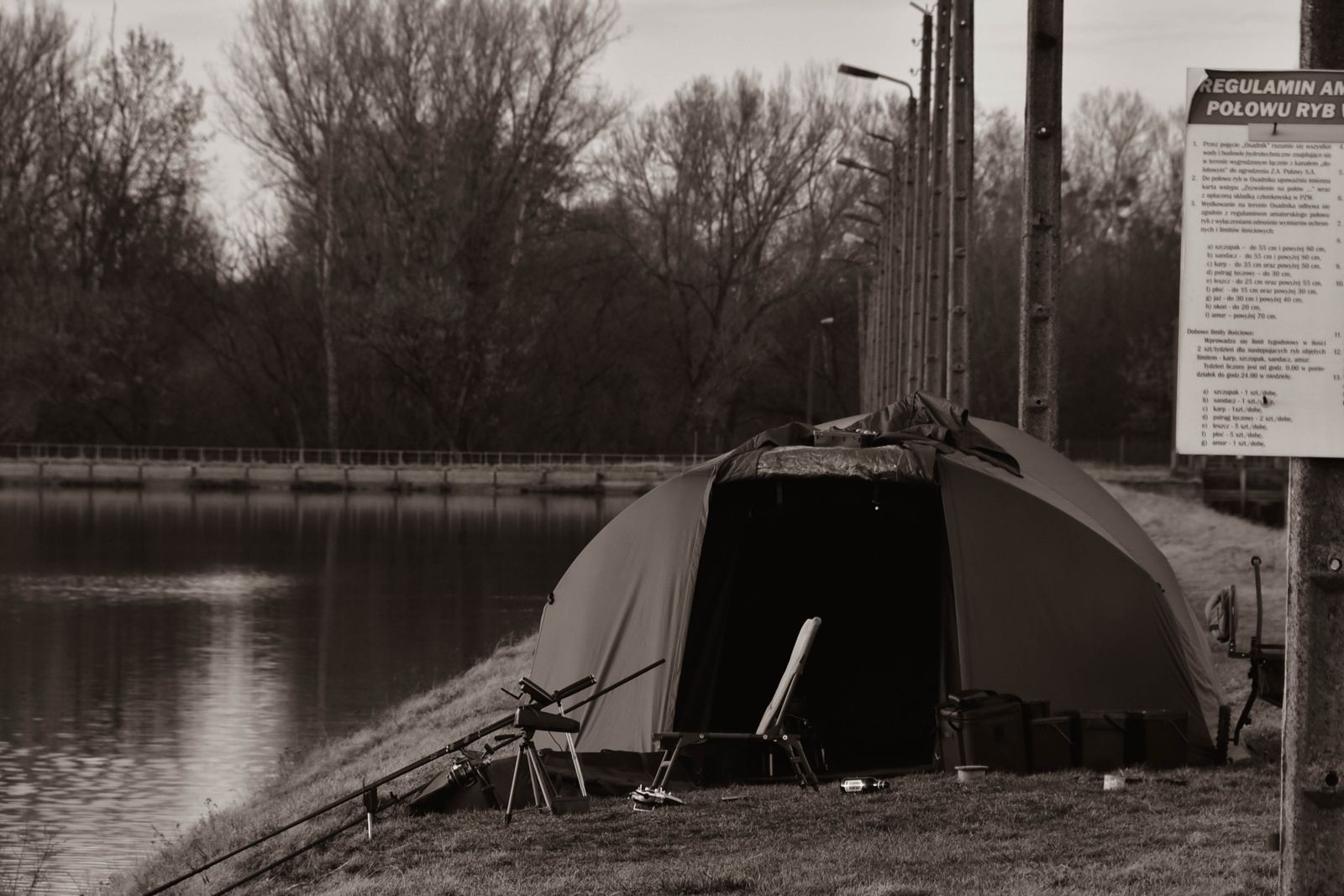
- A bivvy is a closed shelter on a rigid frame with walls, a front and a floor, as the tackle shop eTackle describes it. It is the angler's tent for an overnight or several-night session, and it is heavier and slower to pitch than the others. The heaviest are wheeled to the swim in a barrow.
- A brolly starts life as a large fishing umbrella that can be closed in with side and front panels, and sometimes a groundsheet. Brollies are lighter and quicker to put up than a bivvy, and give less protection.
- A day shelter is lighter and quicker again, made for a day on the bank, without the sleeping room or the weather sealing of an overnight bivvy.
Hill walkers use "bivvy" for a waterproof bag to lie in, which is a different thing altogether; the guide to emergency shelters and survival bivvies covers that kind.
What this shop has, and what it does not
This shop does not sell carp bivvies, fishing brollies or fishing umbrellas. The fishing tents range is made up of tents and shelters whose makers say they are suited to fishing, alongside other uses. It holds:
- Pop-up beach tents and sun shelters, light enough to carry along a bank, for shade and a break from the wind on a summer day. These do the day shelter's job.
- Automatic pop-up tents for three or four, and small single-layer tents for one or two, that you can sleep in. These do the overnight job.
- Thickened cotton winter fishing tents, the warmest here, for sitting out a cold day. Several are also in ice fishing tents.
- Larger tents for a fishing trip of several nights: the Rock Fortress tipi hot tent and a large canvas bell tent.
So if you want a purpose-made carp bivvy or brolly, a tackle shop is the place. If you want a light shelter for the day, a small tent for a night, or a warm winter tent, read on.
Bivvies for overnight sessions
A night on the bank asks the same of a tent as any night: a floor, a door that closes, and protection from rain. It asks two more things besides. You want to see and hear the rods from inside, and you want the tent to go up quickly in the dark in a narrow swim.
The tents here for a night
- Naturehike Automatic Pop-Up Tent, 3 Person. Size: 180 by 210cm. Weight: about 3.6kg. Packed: 78 by 28 by 18cm. Fabric: 210T polyester Oxford. Doors: two, and the roof can be used on its own as a shelter.
- Naturehike 3-4 Person Automatic Pop-Up Tent and the 4 Person Automatic Pop-Up Tent. Opening: one touch. Use: camping, the beach and fishing, as a sun shelter or a tent.
- Single Person Waterproof Tent for Camping, Fishing and Climbing. Size: about 200 by 100 by 100cm. Weight: about 818g. Layers: single. Comes with: two rods and four pegs.
- Ultralight Camping Tent, Single Layer, 1 or 2 Person. Size: 200 by 120 by 120cm for one, 200 by 150 by 120cm for two. Weight: 1,000g or 1,200g. Comes with: a rain fly and four pegs.
- Tomshoo and Ultralight 1/2 Person Single Layer Tents. Fabric: water-resistant polyester with a silver coating rated UPF 30+, a mesh roof and a removable roof shield.
Read each product page for the waterproof rating where the maker gives one, and for what comes in the bag. The guide to waterproof ratings explains the figures.
Condensation by the water
Most of the small tents here are single layer, and air beside water on a still night is damp. In a single-layer tent the moisture from your breath settles on the one skin you are sleeping under, so on a cold night the walls get wet and drip if you brush them. That is not a leak. Tackle shops say the same of single-skin fishing shelters, which is why the better bivvies have a second skin. Keep a vent or the mesh open, keep wet coats and nets by the door, and wipe the walls in the morning. The guide to single, double and triple layer tents explains the difference a second layer makes, and double layer tents has tents with one.
Watching the rods
Mesh doors and windows let you see the water and keep the midges out. The Naturehike three-person tent has two doors, so one can face the rods and the other the bank. Whichever tent you choose, pitch it so that you can reach the rods in a few steps without tripping on a guy line.
Night fishing and the fishery's rules
Before you plan a night on the bank, check the fishery's own rules on night fishing and on tents. In England and Wales you also need a rod licence and the permission of the land or fishery owner, as GOV.UK sets out; there are different rules in Scotland and Northern Ireland.
Brollies and day shelters
For a day session, what most anglers want is shade in summer, a break from the wind, and somewhere dry to sit when a shower comes through, light enough to carry with the rods, the bait and a chair. In this shop the pop-up beach tents and sun shelters do that job.
- 2 Person Ultralight Beach Tent. Size: 220 by 120 by 120cm. Weight: about 925g. Packed: 58 by 7 by 7cm. Fabric: 170T silver-coated polyester, with an Oxford groundsheet and 7mm fibreglass poles.
- Ultralight 2 Person Automatic Pop Up Beach Tent. Size: 220 by 120 by 120cm. Fabric: 170T polyester rated UPF 50+, single layer.
- Pop Up Beach Tent, Windproof UV Sun Shade Canopy. Fabric: nylon and Lycra, which its maker says blocks 98% of UV. Frame: iron poles, with a rod to change the angle. Weight: about 1.7kg. Anchors: sand or rocks.
- Pop Up Beach Tent, Automatic UV Protection Sun Shelter. Size: 142 by 72 by 69cm, low, for lying under. Folded: a disc 46cm across.
Most of these are made for sun first. Several are described as water-resistant rather than given a waterproof rating, so treat them as shade and a windbreak that will see off a shower, not a roof for a day of steady rain. For something closed in against rain and wind, the Pop-Up Single Person Weather Tent, which its maker describes as rainproof and windproof and suited to fishing, is filed in pop-up shelters. More shade is in sun shelters and beach tents, and a screen against the wind in windbreaks.
Folding a pop-up on the bank
A pop-up opens in seconds and takes practice to fold. Learn it at home with the instructions, not on a windy bank with the rods out. Hold the frame firmly while it is under tension and keep it away from faces, and keep it clear of the water while you fold: a pop-up that springs loose near the edge can end up in the lake.
Winter fishing tents: cotton, padding and the chimney
In winter a fishing shelter becomes a warm box to sit in for hours. The warm ones here are made of thickened or padded cotton, and they are the same tents that fill the triple layer tents range: every tent there is a thickened or padded cotton winter tent.
- Thickened Cotton Winter Ice Fishing Tent. Size: 220 by 220cm, 165cm high. Fabric: five layers of cotton and 210D Oxford cloth. Weight: about 13kg. Packed: 26 by 26 by 135cm. Comes with: four ice nails and four wind ropes.
- Single Winter Fishing Cotton Tent. Size: from 1.8m square and 1.5m high to 2.4m square and 1.8m high, for one angler. Fabric: thickened cotton. Its maker says it is for the bank or the ice.
- Large Hexagonal Cotton-Padded Winter Tent. Size: room for more than one angler and their kit. Colours: ten.
- Chimney Winter Fishing Tent. Size: for three or four, in 1.8m and 2.1m versions. Fabric: thickened cotton and flame-retardant Oxford. Rating: 1,000mm to 1,500mm. Chimney: an opening for a stove pipe.
- Thickened Winter Fishing Tent. Size: for one. Weight: about 2.2kg. Fabric: double-layer 210T coated polyester, windproof. This one is in fishing tents rather than the triple layer range.
Warmth against weight
Padding holds warmth, but it is heavy and packs long: the five-layer tent weighs about 13kg against about 3kg for a pop-up ice fishing tent. So the cotton tents suit a swim near the car park, and a long walk along the bank suits a lighter tent and warmer clothes. Padding does not make a tent more waterproof, and thick cotton takes a long time to dry, so dry it right through at home before you store it, or it will go mouldy. Cotton tents are also in canvas and cotton tents, and other cold-weather tents in winter and snow tents.
The chimney, and stoves
Of the winter fishing tents here, only the Chimney Winter Fishing Tent is made for a stove, and it is filed with the hot tents with a stove jack. A stove goes only in a tent made for one, through the opening made for it, as the guide to winter camping and hot tents sets out in full:
- Use a stove made for tents, whose pipe fits the opening, with its spark arrestor fitted.
- Keep a carbon monoxide alarm inside whenever the stove is lit. The Camping and Caravanning Club suggests one tested to BS EN 50291-2, and Kitemarked.
- Keep a vent open, never leave a lit stove unattended, and let it burn out before you sleep.
- Flame-retardant fabric resists catching light; it is not fireproof.
Never take a barbecue into a fishing tent or its doorway, lit or gone out, and never charcoal. Never use a gas heater, a camping stove or any stove without a flue in a closed fishing shelter. A small closed tent fills with carbon monoxide very quickly, and carbon monoxide kills. Cook outside, away from the tent.
Ice fishing abroad, and staying on the bank in Britain
Ice fishing tents are made for frozen lakes in places with long, hard winters: you pitch the tent on the ice, drill a hole through it, and fish sitting down out of the wind. The pop-up ones spring open on a steel frame and the cotton ones come with ice nails because ordinary pegs will not go into ice.
In Britain: stay off the ice
The Royal Life Saving Society UK advises never going onto ice under any circumstances, and says ice across the UK and Ireland is unlikely to freeze thick enough to walk on safely. So in Britain an ice fishing tent is a winter shelter for the bank, and a very good one. Never walk out onto a frozen lake, pond or canal, however solid it looks, and never go onto the ice after a dog, a rod or a net. Abroad, follow the local rules for the water.
The ice fishing tents here
- Pop Up Ice Fishing Tents, for one or for one or two. Size: 150 by 150cm, 190cm high. Frame: steel brackets. Fabric: 190T polyester with a silver coating. Packed: a flat disc 62 by 62 by 5cm. Weight: about 3kg. Comes with: eight ground nails.
- The cotton tents above: the five-layer quick-open tent, the single cotton tent, the large hexagonal tent and the chimney tent.
The thin pop-ups stop the wind and keep off rain and sun, and they are the easy ones to carry to a far swim. The cotton tents hold warmth far better. All of them are in ice fishing tents.
On a frozen bank
Ground frozen hard bends thin aluminium pegs. Use steel or titanium pegs and drive them straight down with a mallet; a peg with a cord or ring at the top is much easier to pull out once it has frozen in. Use the nails and ropes that come with the tent, every one of them: a closed tent catches the wind like a sail.
Pitching on the bank: pegs, wind and the water's edge
A bank is a hard place to pitch: often narrow, often soft or stony, open to the wind across the water, and right beside something that can rise. The guide to pitching a tent covers the pitch itself; this is what changes beside water.
Where to put it
- A little back from the edge. Pick level ground a few steps back from the water, so you are not pitching on the soft margin and there is room to land a fish in front of the tent.
- Above the water, not in a dip. Rivers rise after rain upstream, sometimes when it has not rained where you are. In England, GOV.UK's Check for flooding service shows flood warnings and river and sea levels; in Scotland look at SEPA, and in Wales at Natural Resources Wales. It cannot warn of sudden surface water flooding, so never pitch in a hollow where water runs.
- On the coast, above the tide. Know the tide times before you set up on a beach or an estuary, and pitch well above the line the highest tides reach.
- Not under trees, and not under power lines. Dead branches fall in a wind. And National Grid warns that carbon fibre rods and poles conduct electricity: do not fish or set up near overhead lines, carry rods flat, and put rods together and take them apart at the water's edge. If a line catches on a power line, do not touch it, and call 105.
Facing the wind and the water
The usual rule is to turn the narrow or low end of a tent into the wind and the door away from it, so rain does not blow in. On a bank you also want the door facing the water. When the wind blows along the bank or from behind you, both work. When it blows straight off the water into the door, put the back of the tent to the wind and watch the rods from a mesh window, or use a windbreak in front of the door.
Pegs for bank ground
- Soft, wet ground and sand. Peg: the wide U-shaped aluminium pegs, 23cm and 31cm long. Why: in loose ground a peg holds by its surface area.
- Hard, stony or frozen ground. Peg: forged steel, in 20cm, 30cm or 40cm. Why: a thin peg bends before it goes in.
- The angle. Push each peg in at about 45 degrees, leaning away from the tent, until only the head shows.
All of these are in tent pegs, with spare cord in guy lines and mallets in tent mallets. Many small tents and pop-ups come with only a few pegs (the automatic UPF 50+ pop-up has two), so take spares. Peg out every guy line, and on a windy bank add your own.
Light after dark
Hang a small light inside so you can find the door and the rods at night without a head torch in everyone's eyes. The fishing range has a small waterproof LED light with a hook, which runs on a button cell.
Questions people ask
Do you sell carp bivvies or fishing brollies?
No. The fishing range has pop-up shelters for the day, small tents and automatic pop-ups for a night, and padded cotton tents for winter. For a purpose-made carp bivvy or brolly, go to a tackle shop.
Can I sleep in a fishing tent here?
The automatic pop-up tents and the small one and two-person tents are made to sleep in. The sun shelters and beach shades are for daytime.
Which tent is warmest for winter fishing?
The thickened cotton tents, and the five-layer quick-open tent most of all. They are heavy, so they suit a swim close to the car.
Can I use a heater in my fishing tent?
Only a stove made for tents, in a tent made for a stove, such as the chimney tent, with a carbon monoxide alarm and a vent open. Never a gas heater, a barbecue or a stove without a flue.
Can I go onto the ice in an ice fishing tent?
Not in Britain. The Royal Life Saving Society UK advises never going onto ice; use the tent on the bank. Abroad, follow the local rules for the water.
Can I camp overnight at a fishery?
Check the fishery's own rules before you go. Each fishery sets its own, and they are the ones that count.
Where to go next
- For the bank: fishing tents, pop-up shelters and sun shelters.
- For winter: ice fishing tents, triple layer tents, canvas and cotton tents, winter and snow tents and hot tents with a stove jack.
- To hold it down: tent pegs, guy lines and tent mallets.
- Read on: winter camping and hot tents, single, double and triple layer tents, how to pitch a tent and emergency shelters and survival bivvies.
Delivery is included in every price and tracked to your door.