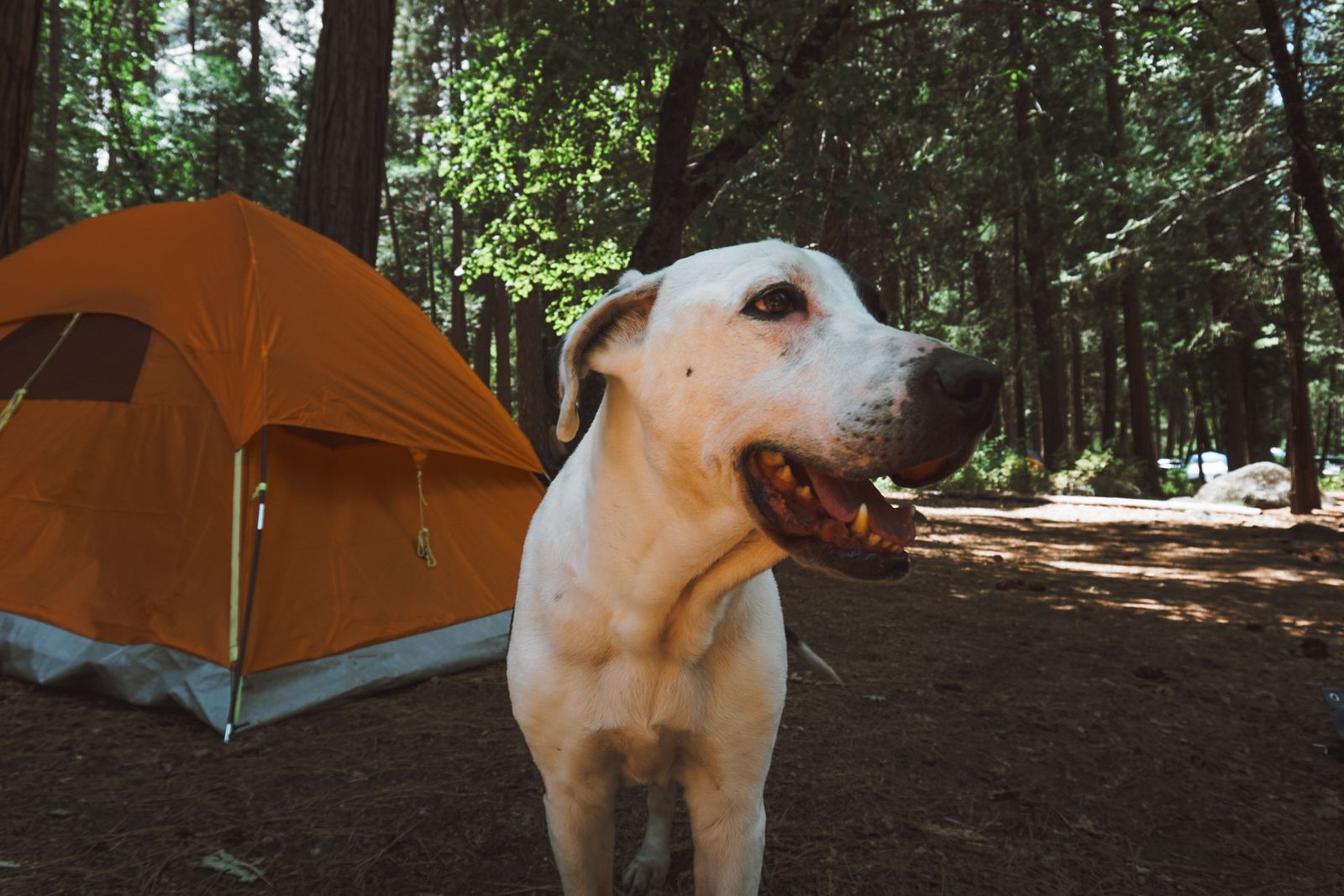
A dog on a camping trip needs a place to lie that is not your sleeping bag, shade on a hot afternoon, a dry bed on a wet night, and a lead and a tag on a campsite full of strangers. This guide covers the dog's own tents in the shop, making room for the dog in yours, heat, cold and mud, campsite manners, and cats and small pets. The welfare advice in it comes from the RSPCA, the PDSA, Dogs Trust and GOV.UK, and each is named where it is used.
Dog tents, kennels and pop-up shelters: what the shop has
The pet tents here are small tents made for a dog or a cat, not for people. The pet tents range holds all of them, and dog tents has the ones made for dogs. Many are made for small dogs and cats alike, so the same tent often appears in the cat tents range too. There are no solid wooden kennels among them; the nearest thing is the large insulated fabric tents. They fall into five kinds.
- Camping and sun shelters. The foldable dog camping tent is silver-coated polyester, sold as waterproof and sun-protective, with four ground nails and a storage bag. Sizes: M about 40 by 37cm and 43cm high, L 76 by 37cm and 53cm high, XL 77 by 74cm and 70cm high. The portable pop-up dog tent opens on its own and is made to shade small to medium dogs.
- Large insulated tents. Two extra large tents measure 98 by 98cm and 100cm high, with a reflective foil lining, a mesh window with a cover you open or close, and a waterproof outer. They fold out with no poles to fit, and their maker says a medium-sized dog such as a Border Collie has room to turn round and stand.
- Teepee beds and dens. The teepee bed has pine poles, a thick cushion and a washable cover, in sizes for dogs under 5kg, 10kg and 15kg. A canvas teepee with a thick cushion comes in 40, 50 and 60cm square, and is made for indoors.
- Nest tents and pop-up beds. The folding nest tent runs from size S, for pets up to 3kg, to XL, for pets up to 25kg. The pop-up pet tent with a cushion opens to 79 by 77cm and 62cm high, folds to 16 by 56cm and weighs 700g.
- Playpens, enclosures and a travel cage. An octagonal playpen 73cm across has a mesh top that unzips and two zip doors, and a mesh and wire enclosure measures about 120 by 63cm. The travel cage tent folds flat, carries like a backpack and comes in two sizes for small to medium dogs, made for car journeys and trips out.
Size: go by the dog
Size is the thing that goes wrong. Where a product gives a weight, go by your dog's weight. Where it gives measurements, measure your dog lying stretched out and standing, and compare. A dog that sleeps flat on its side needs the longer measurement, not the curled-up one. Most of these tents suit small and medium dogs; the 98cm tents are the largest here. A big dog is often better off on its own bed in the living area of your tent than in a tent of its own.
What a dog tent is for, and what it is not
A dog tent is a place to lie beside you in the shade and a familiar den in a strange place. The RSPCA suggests taking something that smells of home and putting it in the dog's bed to help it settle, and a dog tent used in the garden for a few weeks first does the same job. Peg an outdoor one down, because a light tent with nobody in it blows away, and keep it clear of guy lines. Mesh playpens let rain in as well as air, so they are for fine days.
What a dog tent is not is somewhere to leave a dog on its own. A zip or a mesh panel will not stop a dog that wants to get out, and on a warm day a small tent becomes dangerous, as the next sections explain.
Room for the dog in your own tent
Most people want the dog in the tent with them at night, so choose your own tent with the dog in mind. The guide to tent sizes puts it simply: a big dog takes about the floor of another person, so count it in when you choose the size. The number on the label is the number of sleeping mats that fit side by side with nothing else inside, and a dog is something else.
Where the dog sleeps
Give the dog its own place, in the living area or the porch rather than on the beds. In a tent with a separate living area, that area becomes the dog's room: its bed goes there, the zip of the bedroom stays closed, and wet paws stay off the sleeping bags. The family tents here have room to stand and somewhere to sit, and the two bedroom and living room tents put the bedrooms either side of, or behind, a shared living room. The guide to family tents and layouts explains how those floors are shared out.
By that rule, a couple with a medium-sized dog are comfortable in a 3-man tent, with the dog's bed at the foot or in a porch big enough to lie in. A family of four with a dog, staying a week, wants a 6-man tent with a living area or a tent with two bedrooms.
The porch
The porch, the covered space at the door, is where a dog dries off before coming in. On most small tents the porch has no floor, so put a mat or a bed down rather than leaving the dog on wet grass. The tents with a porch range runs from a trekking tent's small vestibule to the hall of a family tent; check the porch size on each product as well as the inner tent's.
Claws, mesh and the groundsheet
Claws are hard on mesh doors and thin groundsheets. A bed or a blanket of the dog's own spreads its weight, and a rug on top of the groundsheet takes the scratching and is easy to shake out; see tent rugs and carpets. A footprint under the tent protects the groundsheet from stones underneath, so the floor is not being worn from both sides; see groundsheets and footprints. Keep the mesh door zipped when the dog is inside, because a dog that wants to see out will go straight through mesh.
Heat: a tent in the sun is no place to leave a dog
A tent in full sun heats up quickly, and the air inside goes still. A dog shut in one has nowhere cooler to go. The PDSA is plain about it: never leave your pets alone in a conservatory, caravan, shed or tent on a warm day.
The car is no better. The PDSA and the RSPCA both say that on a 22°C day the inside of a car can reach 47°C within an hour, and Dogs Trust says a dog could die in a hot car in just minutes, with an open window not enough to prevent it. So on a campsite, leave the dog in neither while you go to the shower block or the shop. Take the dog, or take turns.
It does not take a heatwave
Dogs Trust reports that a significant number of dogs have been diagnosed with heatstroke when the temperature was only 16.9°C, and that nearly 75% of heat-related illness in UK dogs was linked to exercise, 67.5% from walking alone. The PDSA gives nearly three quarters during play and exercise. The long walk on a warm afternoon is as much of a risk as the tent.
The dogs most at risk
The PDSA and Dogs Trust name the same groups: flat-faced breeds such as Pugs, English Bulldogs and French Bulldogs, older dogs, puppies, overweight dogs, dogs with health conditions, giant and larger breeds, and dogs with thick or long coats. The PDSA says British Bulldogs are 14 times more likely to develop heatstroke than Labradors. If yours is one, plan around the shade.
Keeping a dog cool on the pitch
- Shade and fresh water all day. Dogs Trust asks for both, throughout the day, not just after a walk.
- Walks in the early morning and late evening, which the PDSA, the RSPCA and Dogs Trust all advise, and shorter walks at a gentle pace.
- Test hard ground with your hand. Dogs Trust says hold it on the tarmac for five seconds; the PDSA says if you cannot hold your palm on a surface for seven seconds it is too hot to walk on. Either way, if it is too hot for you, it is too hot for paws.
- Give the dog shade it can move into. A sun shelter beside the tent gives you and the dog a roof with the sides open to the breeze; see sun shelters, and the guide to beach tents and sun shelters for how they are pitched. The silver-coated dog camping tent and the pop-up dog tent are made to shade a dog lying beside you, not to shut one in.
- Open the tent's doors on opposite sides so air moves through it.
The signs of heatstroke
The PDSA lists the signs, from mild to severe:
- Mild. Panting, fast breathing or difficulty breathing, low energy.
- Moderate. Drooling, foaming at the mouth, vomiting, diarrhoea, bright red or very pale gums, shaking, weakness and collapse.
- Severe. Confusion, seizures, unconsciousness, vomiting or diarrhoea with blood.
Dogs Trust adds heavy or continuous panting that goes on even after the dog has stopped exercising.
What to do
Heatstroke is an emergency. The PDSA and Dogs Trust give the same order:
- Move the dog into shade or the coolest place you have.
- Start cooling straight away. The PDSA says pour cold water over the whole body, starting gently, and that water from the cold tap is fine; Dogs Trust says a young, healthy dog can be put in water cooler than itself, and an older dog or one with a health condition sprayed with room-temperature water. Keep the water away from the nose and mouth.
- Make a breeze, and offer water to drink without forcing it.
- Do not cover the dog with a wet towel, which both charities say can make it hotter, and the PDSA adds do not cuddle it.
- Ring a vet straight away, and keep cooling the dog on the way there.
Before you go, look up the nearest vet to the campsite and its out-of-hours number, as the RSPCA advises.
Cold, wet and muddy: a bed, a mat, a towel
A night in a tent can be cold even in summer, and the ground draws heat out of anything lying on it. The RSPCA names small, slim, young and old dogs, and those with little or no fur, as the ones most at risk when it gets near freezing. A dog that has spent the day getting wet is colder again.
Off the ground
Give the dog a bed that lifts it off the groundsheet: a cushion bed, a folded blanket on a mat, or its own bed from home. The insulated pet tents here have a reflective foil lining and a cover that closes over the mesh window on a cold night. The foil mat in the groundsheets range can go under or inside a tent as a warm layer, and a rug on top of the groundsheet makes the living area warmer for everyone.
Drying off
Dry the dog with a towel after rain, a swim or a muddy walk. The RSPCA says use a towel or a hair dryer, because damp fur can lead to sore skin and matting, and the PDSA warns that a dog that stays wet and gets cold is at risk of hypothermia. Keep two towels in the porch, one for paws and one for the rest of the dog, so mud stops at the door.
The RSPCA says older and young dogs, dogs with thin or short fur and dogs with health conditions need a coat in the cold; the PDSA suggests one that is windproof, waterproof and easy to wash.
The signs of getting too cold
The RSPCA lists shivering, drowsiness or confusion, pale gums and loss of coordination, and collapse in a severe case, and notes that shivering stops when a dog becomes severely cold. Get the dog somewhere warm and ring a vet straight away.
No heater in the tent
Keep the dog warm with bedding, never with a heater, stove or barbecue in the tent or the porch. They can set a tent alight and give off carbon monoxide, which is as deadly to a dog as to a person. The only stove that belongs in a tent is a hot tent's own stove, through its stove jack, with a carbon monoxide alarm, and a dog should be kept well clear of it.
On a campsite: leads, noise and the rules
Not every campsite takes dogs, and those that do set their own rules, so check the site's own rules before you book. The RSPCA suggests making sure anywhere you stay has a dog-friendly policy and telling them in advance that the dog is coming.
A tag and a microchip
GOV.UK says all dogs in the UK must be microchipped and registered by the time they are 8 weeks old, that the details on the database must be kept up to date, and that a dog must wear a collar and tag with the owner's name and address in a public place. The fine for a dog that is not microchipped can be up to £500. For a trip, the RSPCA suggests a tag with your holiday address and contact details, because a dog that slips its lead on a strange campsite does not know its way back.
Leads and the countryside
Off the campsite, the Countryside Code on GOV.UK says to keep your dog on a lead or in sight, and to be confident it will come back when called. It is good practice to use a lead around livestock anywhere. On Open Access land and at the coast, you must put your dog on a lead around livestock, and between 1 March and 31 July you must have it on a lead on Open Access land even where there are no animals. A farmer can shoot a dog that is attacking or chasing livestock. If cattle or horses come at you, the Code says let the dog off the lead, because you will both get to safety more easily.
Poo
The Code says always clean up after your dog: bag it and bin it, or take it home if there is no bin, and never leave bags lying about.
Noise and the neighbours
Tents are close together and fabric stops no sound. Pitch with the door facing away from paths, keep the dog with you, and settle it at night the way you do at home. A night in your own tent in the garden before the trip lets the dog get used to the sounds and smells.
Ticks
The NHS asks people to check pets for ticks after time outdoors. The PDSA says ticks on dogs are most often found on the head, ears, armpits, groin and tummy. Pack a tick tool: the PDSA advises sliding it under the tick, close to the skin, and twisting, and both the PDSA and the NHS say never squeeze or crush a tick.
Food, water and medicine
Take the dog's own food, bowls, water for the journey, its bed and enough of any medicine for the whole trip, as the RSPCA advises. The camping checklist has a list for dogs.
Cats and small pets
Cats are a different matter. The RSPCA says cats, rabbits and small animals that are not used to travelling and visiting new places should not be taken on holiday, because it is likely to be too stressful for them, and that care at home with a sitter is usually best. So most of the cat tents here are made for home and the garden rather than the campsite.
- Mesh enclosures and playpens. Pop-up mesh spheres about 68cm across with a large zip door, and round and octagonal pens that fold flat.
- Closed dens for indoors, from 35 by 35cm and 30cm high, for a cat to curl up and hide in.
- Outdoor cat houses. Waterproof, insulated shelters with a door flap, one sold for feral, stray and pet cats living outdoors.
For a cat that does travel
For a cat that is used to travelling, the RSPCA says it needs hiding places and a carrier it is comfortable in, with something that smells familiar inside. An enclosure lets a cat sit out in the air on a campsite while staying contained. Check the zip closes fully, keep it out of full sun, and never leave a cat in one alone: the PDSA's warning about tents on warm days covers every pet. GOV.UK says cats in England must be microchipped by 20 weeks old, indoor cats included.
Rabbits and small animals
For small animals that do travel, the RSPCA suggests keeping them with companions they know, keeping noise down, and giving them food and water all the time. The same rule on heat applies: shade, water, and never alone in a tent in the sun.
Questions people ask
Can my dog sleep in the tent with us?
Yes. Give it its own bed in the living area or a big porch, keep the bedroom zipped, and choose a tent one size bigger.
Can I leave my dog in a dog tent while we go out?
Not on a warm day, as the PDSA says, and a dog tent is not built to hold a dog that wants to get out. Take the dog with you, or take turns.
Will my dog's claws damage the tent?
They can, mostly on mesh and thin groundsheets. A bed or rug under the dog and a footprint under the tent protect the floor, and keeping the mesh door zipped stops a dog going through it. For a small hole, see tent repair kits.
Which dog tent suits a big dog?
The largest here are the 98cm insulated tents. A big dog is often better on its own bed in your tent's living area.
Can I take my dog wild camping?
The same rules apply as for the people with it, so read the guide to wild camping in the UK first. On top of that, the Countryside Code's lead rules apply on Open Access land and around livestock.
Where to go next
- Dog tents and all pet tents
- Cat tents
- Family tents, with room for the dog
- Sun shelters for shade on the pitch
- Tent sizes explained
- The camping checklist