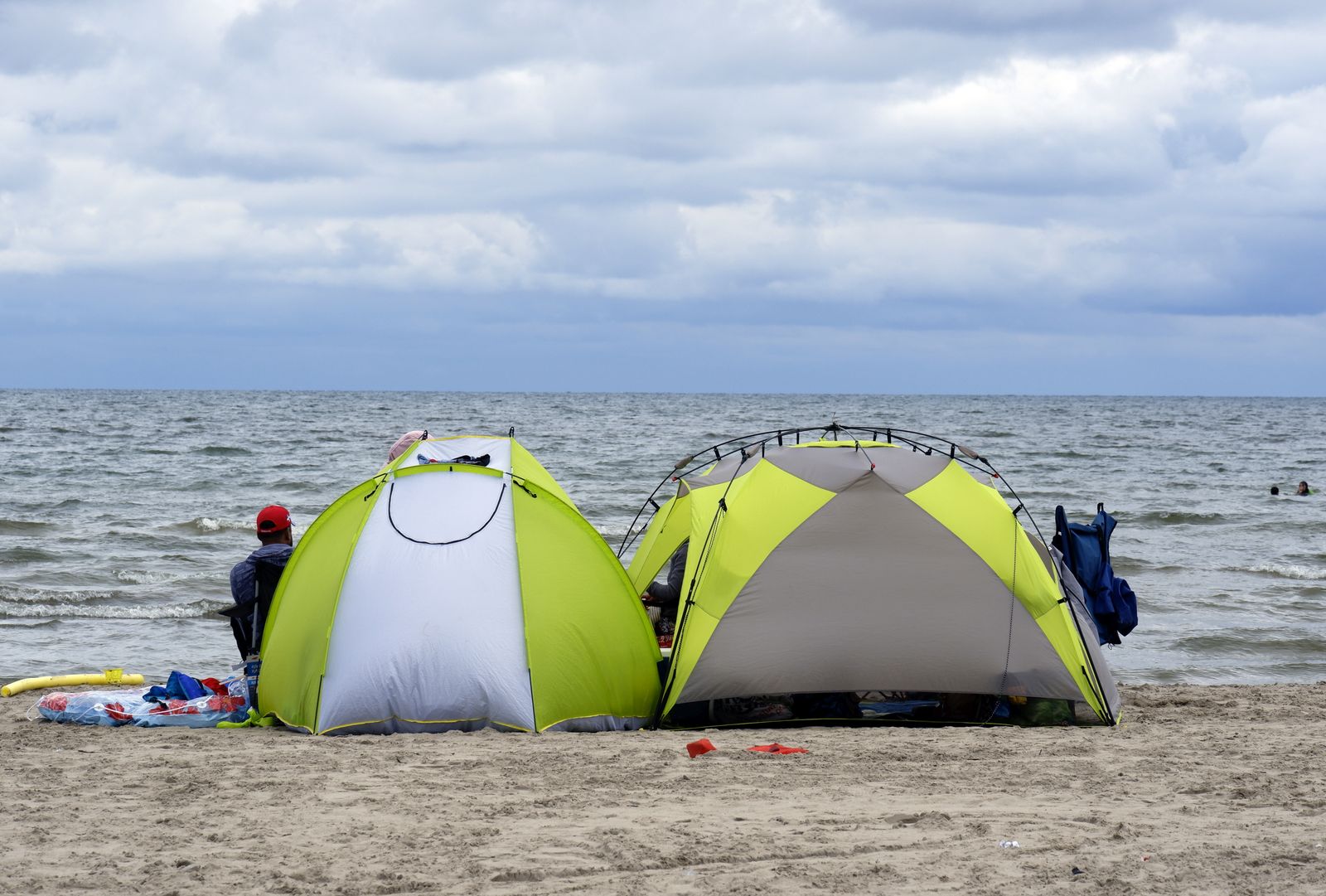
A beach tent is not a tent you sleep in, most of the time. It is somewhere in the shade for the hottest hours, a break from the wind that blows sand across the towels, and a place to change out of a wet swimming costume without an audience. Choosing one is mostly a matter of how much shade, how much shelter from the wind and how much privacy you want, and how far you will carry it from the car. This guide covers the kinds of beach tent and shelter, what the UPF figure on them means, how to hold one down in sand and wind, which size suits a couple, a family or a baby, and how to bring it home without half the beach inside it.
What a beach tent is for: shade, wind and somewhere to change
Three things send people to the beach with a tent, and most beach tents do one of them better than the others.
Shade
On a sunny day there is no shade on a beach. A beach tent gives a patch of it for a nap, a picnic or a baby, and a fabric made to block ultraviolet light gives more protection than a towel over a windbreak. Shade alone is not the whole answer, though. The NHS points out that water and sand reflect the sun's UV, which increases your exposure, and the World Health Organization puts dry beach sand at about 15% and sea foam at about 25%. Light bounces in under the edges of any shelter, so hats, sun cream and covering up still matter in the shade.
Wind
Beaches are windy, and even a light breeze picks up dry sand and throws it at ankles and food. A tent or shelter with a closed back, or a windbreak along one side, makes a calm patch to sit in.
Somewhere to change
Many beaches have no changing rooms, or they are a long walk away. A closed beach tent, or a tall changing tent made for it, lets you change in private and keeps a bag of dry clothes out of the sand.
Most of the tents in beach tents are pop-up sun shelters with an open front, light and quick to put up. The range also holds small baby tents, family pop-ups that suit the beach by day and the campsite by night, and mats for the sand. A beach tent is mostly made for sun, not for rain: many give a UV figure and no waterproof rating at all, so treat those as shade.
Pop-up beach tents, sun shelters and canopies
There are four main kinds, and the difference between them is how much is closed in.
Pop-up beach tents
A pop-up beach tent has a sprung frame folded inside its bag. Let it go and it opens by itself, usually with a floor, a closed back and sides, and an open front or a door. Most have mesh panels to let the breeze through. The Instant Pop Up Beach Tent for 3 to 4 people is a typical one: 130 by 130cm and 110cm high, with mesh sunshade panels all round. Small ones fold to a flat disc that goes under your arm. See pop-up shelters and pop-up tents.
Sun shelters
A sun shelter is shade first: a roof with one or more sides left open, so the air moves through. Some are low pop-ups for one or two to lie under; others are a stretchy fabric canopy on iron poles, such as the Beach Sun Shade Awning here, which weighs about 1.6kg and has a rod to change the angle of the shade. See sun shelters.
Canopies and shade sails
For a group, a canopy gives a big roof and nothing else. The 500 by 300cm beach canopy here shades four to eight people, comes with wind-resistant stakes, and its maker says it goes up in about three minutes with one person. A shade sail, such as the 3m triangle sail here, is a sheet tied out between poles or posts, better in a garden than on open sand.
Family pop-up tents
A few pop-ups are proper tents for a family, with a door and a floor, which suit the beach by day and a campsite at night. The Folding Hexagonal Pop Up Beach Tent sleeps four to six at 300 by 240cm, with a flysheet rated 1,500mm to 2,000mm and a tub floor rated 2,000mm to 3,000mm. If you mean to sleep in one, read the waterproof rating first: one automatic pop-up beach tent here is rated only 400mm, which is a shower-proof cover, not a tent for a night of rain. The festival tent guide has more on pop-ups for sleeping in, and how to fold them.
Folding it away
Opening is the easy half. A sprung pop-up has to be twisted back into its loops before it fits in the bag, and each maker's way is slightly different. Practise at home with the instructions, not on a windy beach with everyone waiting. Hold the frame firmly and keep it away from faces while it is under tension.
Sun protection: what UPF means
A beach tent's fabric is often given a UPF figure, the ultraviolet protection factor. It says how much the fabric cuts the ultraviolet light getting through it. A UPF 50 fabric lets through about one fiftieth of the sun's UV, so it blocks about 98%. A UPF 30 fabric lets through about one thirtieth, so it blocks about 97%. The higher the number, the less gets through.
The UPF scale comes from the standards for sun-protective clothing. In Europe, clothing that passes EN 13758-2 is labelled UPF 40+. In Australia and New Zealand, AS/NZS 4399 rates fabric up to 50, and anything above is labelled 50+, which is where "UPF 50+" comes from. Tent makers use the same figures, but the product pages here do not say which standard a tent was tested to, so take a UPF figure as the maker's own statement. Australian sun-protection agencies also note that a fabric protects less when it is wet or stretched.
The figures on the shop's beach tents and shelters come in three forms:
- UPF 50+. On: the pop-up beach tents for 3 to 4, the ultralight 2-person pop-up beach tent, the baby beach tents with a pool, the 500 by 300cm canopy and a pop-up shower tent.
- UPF 30+. On: several single-layer camping tents with a silver anti-UV coating, such as the Tomshoo tents for one or two.
- A percentage. On: the stretch-fabric sun shades and the family pop-up beach tent, which say they block 98% of UV, a 1-2 person pop-up that blocks up to 98%, and tarps that block over 90%, or over 95% when silver-coated.
A silver coating on the outside reflects heat as well as UV, so the tent stays cooler inside. But no shade is complete. The sun moves round, so turn the opening away from it every hour or two, and remember the light reflected off sand and water. The NHS says to spend time in the shade when the sun is strongest, which in the UK is between 11am and 3pm from March to October, and to use a sunscreen of at least SPF 30 with at least 4-star UVA protection, reapplied every two hours and after swimming.
Pegging in sand: sandbags and long pegs
A peg holds by friction against the ground around it, and dry sand has very little to give. The short pegs that come with most beach tents pull straight out of it. There are four ways to do better.
Long, wide pegs
A peg holds in sand by its surface area, so longer and wider pegs grip better. The U-shaped aluminium pegs here, 23cm and 31cm long, are made for sand and snow. Push them in all the way, so only the head shows, leaning away from the tent. Damp sand near the waterline holds far better than the dry, loose sand at the top of the beach. See tent pegs.
Sandbags
Many beach tents have pockets or flaps round the bottom to fill with sand, or come with bags. The Quick-Open Beach Tent here comes with four sandbags as well as eight stakes and four ropes. Fill them full. Weight sitting on the sand helps, but it is extra weight, not an anchor: for a strong wind, bury the bags too.
Sand and rocks as anchors
Some shelters are made to be held down by the beach itself. The stretch-fabric sun shades here have pockets at the ends that you fill with sand or rocks, so they need no pegs at all; their makers say they anchor naturally that way.
The deadman
Where nothing else holds, bury the anchor sideways. Tie the guy line to the middle of a peg, a stick or a bag filled with sand, lay it in a trench across the direction of the pull, and pack the sand back over it firmly. The weight of sand on top holds it far better than a peg pushed straight down. Check the lines after half an hour, because the sand settles and the lines go slack.
Whatever you use, peg a pop-up as soon as it opens. It is light for its size, and an empty one blows away very easily, across a beach full of people.
Wind on the beach: windbreaks and which way to face
Wind on a beach often changes during the day. The Met Office explains the sea breeze: on a calm, sunny day the land warms up faster than the sea, the warm air over the land rises, and cooler air flows in from the sea to replace it. That breeze tends to build through the day, so a calm morning can turn into a breezy afternoon blowing onshore, off the sea. Check which way the wind is blowing when you arrive, and check again after lunch.
Which way to face
Pitch with the closed back of the tent to the wind, so the opening faces away from it. Wind blowing into an open front fills the tent like a sail and lifts it. Then think about the sun: the best pitch has the back to the wind and the shade where you want to sit, and on some days you cannot have both. When the wind matters more, as it usually does, face away from the wind and move round inside the shade. Open the mesh windows on the far side on a hot day to let air through.
Windbreaks
A windbreak is a fabric screen on upright poles, pegged in a line or round two or three sides of where you sit. It has no roof, so put it beside a sun shelter: the screen takes the wind and the shelter takes the sun. Set it across the wind, a little upwind of where you sit, with the guy ropes on the side the wind comes from. Push the poles deep into the sand and pull the fabric tight, because a slack screen flaps and works its poles loose. There are two in windbreaks: a folding screen in 65/35 polycotton with a clear TPU window to see out, whose panels zip together into a longer screen, and a large folding privacy screen in black or khaki.
When to take it down
If the wind is strong enough to bend the poles or lift a corner, take the shelter down rather than holding it. The same wind is a warning for the water: the RNLI says never to use inflatables in an offshore or strong wind, which the orange windsock on a lifeguarded beach shows. A beach's own rules may also limit tents, windbreaks or where they go, so check the beach's own rules before you go.
Sizes for a couple, a family, a baby
A beach tent's person count is usually the number of people who can sit or lie in its shade, not sleep in it. Look at the measurements as well.
For one or two
A couple wants room for two to lie in the shade, with bags at the back. The Ultralight 2 Person Automatic Pop Up Beach Tent here is 220 by 120cm and 120cm high, in UPF 50+ fabric. The stretch-fabric sun shades come in 200 by 160cm and 200 by 210cm and weigh about 1.7kg. A 1-2 person pop-up shelter weighs about 1200g. At this size the weight hardly matters, so choose by how much shade you want.
For a family
For a family of four, look at a tent around 2m square or bigger, or a canopy. The Quick-Open Beach Tent is 210 by 210cm and 130cm high for three or four; the family pop-up tents here go up to four to six; and the 500 by 300cm canopy shades four to eight. Remember the walk from the car park: a bigger tent and a cool box are a lot to carry across soft sand. Picnic shelters, canopies and the mats to go under them are in picnic shelters and mats.
For a baby
Small baby beach tents are made to give a baby a patch of shade on the sand. Several here have a shallow pool built into the floor or a removable pool section: the UPF50+ Baby Beach Tent with Pool weighs about 400g and is 120 by 83cm, and the 2 in 1 Baby Beach Tent with Pool is made for children under three. They give shade, not supervision, and a baby in a pool always needs an adult beside them.
For babies, follow the NHS. It says babies under six months should be kept out of direct sunlight, and that sunscreen is not recommended for them, so shade and clothing do the work. From six months, it advises a sunscreen of at least SPF 30 that protects against both UVA and UVB, applied regularly. Children should wear a sunhat with a wide brim or a long flap at the back, and babies and young children need plenty of fluids to avoid becoming dehydrated. The NHS also warns against covering a pram or pushchair with a blanket, because it can make a baby overheat; in the same way, keep the sides of a small tent open so the air moves through, and never leave a baby in a closed tent in the sun.
For changing
For changing, height matters more than floor space. The stand-up pop-up changing tents are mostly 120 by 120cm and 190cm tall, room for most adults to stand and pull on a wetsuit. A fold-flat changing room 60 by 60cm and 140cm tall weighs about 250g, but most adults will crouch in it. Tailgate tents strap to an open car boot, which is the steadiest choice when you can park near the beach. See changing tents.
Packing up sand-free
Sand gets everywhere, and a tent packed full of it is heavy, scratches the fabric and grinds in the zips. A few minutes at the end of the day saves a lot of shaking out in the garden.
- Before you go, lay a mat at the door. A sand-proof beach blanket, such as the 150 by 200cm one here, or a moisture-proof picnic mat at the entrance catches most of the sand off feet. Take shoes off outside.
- Empty it while it stands. Take everything out, then lift the back of the tent so the sand runs out of the door, or turn a small pop-up upside down and shake it.
- Brush the floor and the zips. A soft brush clears the corners and the zip teeth. Close the zips before you fold the tent, so sand cannot get into them.
- Empty the sandbags and pockets well away from the tent, and knock the sand off the pegs before they go in their bag.
- Dry it before you store it. A tent that went into its bag damp, with sea spray or wet towels in it, needs to come out at home. Rinse off salt with fresh water, and let the tent dry fully before you put it away, or it will go mouldy.
- Fold the pop-up the way you practised. If it fights you, stop and start again rather than forcing the frame.
Sunlight wears tent fabric down slowly, so store a beach tent out of the light at home, and do not leave it pitched in the garden for weeks. The guide to tent fabrics explains why.
Questions people ask
Is UPF 50+ much better than UPF 30+?
UPF 50 lets through about one fiftieth of the UV, and UPF 30 about one thirtieth: about 98% blocked against about 97%. Both are good. Shade, hats and sun cream matter more than the difference.
Are beach tents waterproof?
Some are and many are not. Many give only a UV figure, which means shade. Where a rating is given, about 1,000mm is the lowest usually called waterproof; one beach tent here is rated 400mm.
Can a baby sleep in a beach tent?
A baby can nap in the shade of one with an adult beside them. Keep the sides open so air moves through, follow the NHS advice on shade, and never leave a baby alone in a tent in the sun.
Why does my pop-up keep blowing over?
The wind is getting under it or into the open front. Turn the back to the wind, use long sand pegs or buried bags at every corner, and tie out the guy lines.
Can I use a beach tent in the garden?
Yes, for shade on the lawn, where ordinary pegs hold well. Take it in at night, and do not leave it up in the sun for weeks.
Where to go next
- For shade on the sand: beach tents, sun shelters and pop-up shelters.
- For wind and privacy: windbreaks and changing tents.
- For a day out or a night as well: picnic shelters and mats and pop-up tents.
- To hold it down: tent pegs.
- Read on: the festival tent guide, tent fabrics explained, how to pitch a tent and gazebos and marquees.
Delivery is included in every price and tracked to your door.