A festival is hard on a tent in its own way. It is carried a long way from the car, pitched in a crowded field, slept in for a few hours after a late night, and taken down tired, often in the rain. It does not need to be big or built for a mountain. It needs to go up quickly, keep you dry, let you sleep past sunrise, be easy to find again, and come home with you at the end. This guide takes each of those in turn, starting with what a festival really asks of a tent.
The tents chosen for this are in festival tents: small tents for one to four people, from pop-ups that open in seconds to light double-layer tents and a clear dome. For choosing a tent more widely, see how to choose a tent.
What a festival asks of a tent
Think through the weekend and the list of what matters writes itself.
- The walk in. Most festivals make you walk from the car park or the bus with everything you have, sometimes a long way across fields. A tent that is light and easy to carry over one shoulder matters more than room to stand up.
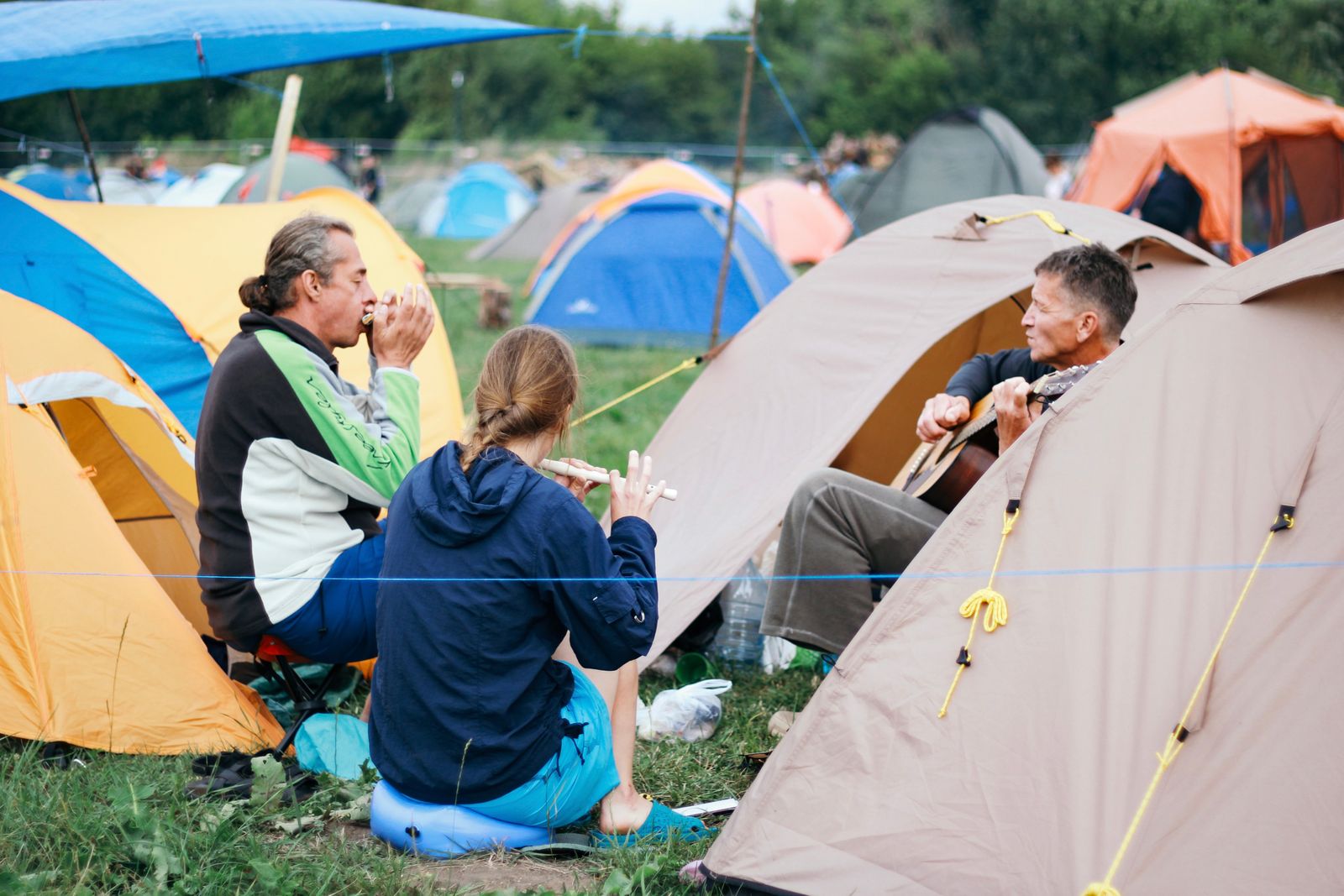
- A crowded field. Pitches are close together and fill fast, often after dark, so a tent that goes up quickly and needs little space is a real help.
- The weather. British summers bring heavy showers, and a field of thousands of people turns to mud quickly. The tent has to keep the rain out for two or three nights without drying out in between.
- The morning. In summer the sun is up early and a tent in full sun heats up quickly, so a festival tent should give you a chance of a few more hours' sleep.
- The people. You are away from the tent most of the day, among thousands of strangers, so what you leave in it matters.
- The end. It has to come down, fold up and go home with you, tired and maybe wet.
What it does not need is a living room, a stove or a 4-season build. Most festival-goers sleep in the tent and live outside it.
Pop-up and instant tents: fast up, awkward down
Pop-up tents are the classic festival tent, because there are no poles to thread: the frame is built in. Several here are made with festivals in mind, such as the Pop Up Tent for 3-4 Persons and the Fully Automatic Pop-Up Tent with Windows. They come in two kinds, and the difference shows most when you take them down.
Spring-frame pop-ups
A spring frame folds into a flat disc and leaps open when you let go of the strap. The Pop Up Tent for 3-4 Persons folds to a disc 72 by 72cm and 5cm thick and weighs about 3.8kg. A disc that size does not go in a rucksack: it goes over your shoulder on its strap, which is easy on a short walk and awkward on a long one or in a crowd. Folding it back down takes a twist of the frame that most people get wrong the first few times. Practise it at home, more than once, before the festival, because a field at the end of a weekend is no place to learn.
Push-up and automatic frames
The other kind has a frame like a large umbrella. You lift the top or pull a strap and it locks open, and you press the frame to fold it down again, as with the Pop-Up Family Camping Tent for three. These pack longer and thinner rather than flat: the Naturehike Automatic Pop-Up Tent for three people packs to 78 by 28 by 18cm and weighs about 3.6kg, and the 3-4 Person Automatic Pop Up Camping Tent, Double Layer, to 80 by 13 by 13cm and about 3.5kg. A long, thin bag is easier to carry through a crowd than a disc. See instant and automatic tents.
What every pop-up still needs
Pegs and guy lines, every time. A pop-up is light for its size, and a gust under the door can lift an empty one off the ground. And because the frame is built into the fabric, a broken part is harder to replace than a single pole on an ordinary tent. Treat the frame gently when you fold it.
Shade or shelter
This is the question to ask of every pop-up tent. Many are beach shelters, made for shade, with an open front and a UV rating, and not meant for a night of rain. For a festival, look for a double layer, a flysheet or rainfly, and a stated waterproof rating. The Pop Up Tent, 4-6 Person Automatic, for example, comes as a single-layer version at 4.2kg and a double-layer version at 5.6kg, and the double is the one for a wet weekend. The Instant Pop Up Camping Tent with Rainfly and the Pop-Up Family Camping Tent, whose flysheet doubles as an awning, are others with a separate fly. See pop-up tents.
Or a small pole tent
A light dome takes a few minutes longer to pitch and packs much smaller. The OneTigris COSMITTO, a two-person dome, folds to 50 by 16cm and weighs 2,450g, and most domes stand up before you peg them, so you can turn the door where you want it. If the walk in is long, or you want a tent that also does a weekend's walking, a small pole tent is often the better choice. See dome tents.
Size: room for the kit and the mud
The number on a tent's label is the number of sleeping mats that fit side by side on the floor, with nothing else inside. At a festival there is always something else inside: bags, boots, wet waterproofs, food and drink. So buy one size up from the number of people sleeping in it. Two friends are comfortable in a 3-man tent with their bags inside; one person has room to spread out in a 2-man tent. The guide to tent sizes shows how to read the floor measurements on a product page.
Why the bags come inside
On a campsite you might leave bags in the porch. At a festival most people keep them inside the inner tent, out of sight and out of the wet, which is why that extra size matters. A porch is still worth having for the muddy things: boots and wet coats stay there, under the flysheet, and out of your sleeping bag. Double-layer tents have one because the flysheet reaches past the inner door; the Naturehike Cloud River, for two or three, has a large one.
Keeping the mud out
- Take your boots off in the porch, every time, and keep a carrier bag there to put them in.
- A floor that rises a few centimetres up the walls keeps puddles out better than a flat sheet. One trekking tent here has a raised door threshold of about 15cm for the same reason.
- A footprint under the tent keeps the underside cleaner and protects the floor. Make it a little smaller than the floor, or fold its edges under, because any part that sticks out catches rain and runs it underneath you. See groundsheets and footprints.
- A small mat or towel just inside the door catches what the boots leave behind.
Not too big
A big tent is harder to carry, harder to find room for in a full field, and slower to pitch and pack. Leave the family tent with bedrooms for the campsite beside the car. If you want to sit up properly, change in comfort or bring a camp bed, the clear dome here, 180 by 130cm and 160cm high, has the height, though it is a tent for warm, dry weather and very little privacy.
Keeping dry, and a dark bedroom for the morning
The rating, the seams and the pitch
The waterproof figure in millimetres on a product page is the hydrostatic head, measured to BS EN ISO 811. About 1,000mm is the lowest figure usually called waterproof, and around 1,500mm to 3,000mm suits most camping in Britain from spring to autumn. The guide to tent waterproof ratings explains the test and the two figures. Among the festival tents here, the Double Layer Backpacking Tent for two has a 3,000mm flysheet and a 4,000mm floor, and the Ultralight 1 Person Tent comes with a 2,000mm or 3,000mm outer, while the Ultralight 1/2 Person Single Layer Camping Tent says only that it is water-resistant, made for sun and light rain. Check each one, and look for taped seams and a flap over the zip. See tents waterproof to 3,000mm.
Where you pitch matters as much. Choose the highest, flattest ground you can find, never a dip, where the water collects after a downpour, and keep away from paths, where people walk through your guy lines at night. Pull the flysheet taut so it does not touch the inner, and peg out every line.
Condensation
A small tent with two people and a pile of damp clothes inside will be wet on the inside by morning, even on a dry night, from the moisture you breathe out. It is not a leak. A double-layer tent keeps that water on the flysheet rather than on you, which is one more reason to choose one; open the vents every night and keep wet things in the porch. See double layer tents.
The morning sun
In London at midsummer the sun rises before five in the morning, and a tent in full sun fills with light and heats up quickly soon after. Some things help.
- A double-layer tent with a solid inner is darker inside than a single skin or a mesh inner.
- Some tents are made to keep light out. The OneTigris Stella, a one- or two-person dome, has what its maker calls a removable blackout outer tent.
- A silver-coated flysheet reflects some of the sun's heat, which is why many beach tents and single-layer tents have one.
- If you have the choice, pitch where a hedge or trees will shade the tent early in the day, near them but not tight against them.
- Open the vents and a door as soon as you wake, to let the heat out.
- Pack an eye mask and earplugs. In a field of tents, they do more for your sleep than anything else.
Light at night
A light hung from the loop in the roof is far easier than a torch for finding things in a bag. A warm white setting is easier on the eyes in a small tent than bright white, and a red mode lets you see without dazzling anyone. Several lights here also charge a phone from their own battery. Never use a candle or anything with a flame inside a tent. See tent lights.
Finding your tent in a field of tents
A camping field at a big festival can hold thousands of tents, and in the dark, after rain, they all look much the same. Plan for finding it again before you walk away from it the first time.
Make it easy to spot
- Choose a colour you will recognise. Many tents come in more than one: the Naturehike Cloud River in white or brown, the 2-3 Person 4 Season Camping Tent in blue, grey or orange.
- Add something of your own to the tent itself, such as a ribbon or a small flag tied to the top, or a distinctive mat outside the door.
- Leave a solar or battery light glowing inside when you go out in the evening, and you will see it from across the field.
- Reflective guy lines catch a torch beam. Some tents here come with them, such as the 2 Person Ultralight Silnylon Tent with six reflective guy ropes. Most of the lines in guy lines are reflective, and some have buckles that glow in the dark.
Remember where it is
Note a fixed landmark near your pitch, such as a tower, a tree or a sign, never another tent or a car, because both move. Take a photo of the view from your door, and save the spot on your phone's map while you have signal. Tell your friends where you are, and if you arrive together, pitch together. Keep your phone charged so the map is there when you need it: a lantern that doubles as a power bank helps.
Keep the lines tidy
Guy lines between tents are what people trip over at night. Peg them out tight, in line with the seams, so they are easy to see, and pull them in as close as the tent allows. Pegs with a bright or reflective pull cord are easier to see and to find again at the end. See tent pegs.
Keeping things safe: what not to leave in a tent
A tent cannot be made secure. A zip opens in a second and the fabric can be cut. So the rule is simple: anything you cannot afford to lose should not be left in it.
What to take with you, or leave at home
Police advice for festivals names phones, laptops, tablets and cash as the things most often stolen, and says that if you cannot take your valuables with you when you leave the tent, leave them at home. Bring only the cards and cash you need, and split them between pockets rather than keeping them all in one place. If the festival has lockers, use them, and if you arrived by car, police advice is to keep anything of value locked in it, out of sight. Your car keys are one of the most important things you have that weekend, so keep them on you.
Padlocks
Advice on padlocking the zips is divided. Some festival guidance says a padlock tells a thief there is something worth taking, and that a thief will cut the fabric anyway; some police advice suggests a lock where possible, to stop casual opening. Either way, a lock is not a safe, so it does not change what you leave inside. If you see someone going through tents, tell the stewards or the police rather than confronting them yourself.
Fire and fumes
Tent fabric burns fast; fire services warn that a fire can destroy a tent in under a minute. So:
- never use a candle in or near a tent;
- never take a barbecue, a camping stove or a heater into a tent or its porch, lit or recently out. Charcoal gives off carbon monoxide even as it cools, and carbon monoxide has no smell and kills;
- cook outside, well away from your tent and everyone else's;
- keep gas cylinders outside the tent and out of the sun, and do not leave glass bottles lying in the sun, which can start a fire on dry grass;
- fire services advise leaving about six metres between tents. On a crowded festival field you rarely get that, which is all the more reason to keep flames away;
- know how you would get out in a hurry, including cutting through the back of the tent if the door is blocked.
Taking it home: no tent left behind
A tent is not meant to be used once. The Association of Independent Festivals estimated in 2019, when it began its campaign "Take Your Tent Home", that about 250,000 tents are left at UK festivals every year, and that most are not collected by charities and cannot be recycled, so they go to landfill. Many people leave a tent assuming someone will take it on. Most of the time, nobody does.
Plan the take-down
- Practise folding a pop-up at home, so the last morning is not the first time.
- Pack a large bin bag for the tent if it is wet or muddy, so it does not soak the rest of your kit on the walk out.
- Take the tent down in the reverse order you put it up: empty it, guy lines first, then pegs, then the frame.
- Pull pegs out by their heads or with another peg hooked under them, not by yanking the guy line, which bends them and frays the line.
- Count the pegs back into their bag. A peg left in a field is lost, and a hazard for whoever uses the field next.
- Pick up your rubbish and leave the pitch as you found it.
At home
Get the tent out of its bag as soon as you are home, and dry it right through, in the garden, a garage or over a clothes airer, before it goes away. A tent packed wet goes mouldy within days, and the coating breaks down. Brush off dried mud once it is dry rather than scrubbing it wet, and clean it by hand with a sponge and cool water, never in a washing machine. Then it is ready for the next festival, or a weekend on a campsite.
Questions people ask
Is a pop-up tent a good choice for a festival?
It is the quickest to pitch, which matters when you arrive late into a full field. Choose one with a flysheet and a stated waterproof rating, not a beach shelter, and practise folding it at home before you go.
What size tent do two people need at a festival?
A 3-man tent, so both bags fit inside with you. A 2-man tent will sleep two, but the bags then go in the porch, where they get wet and are easier to take.
Should I put a padlock on my tent?
Advice is divided. It may stop someone casually opening the zip, but it will not stop a thief with a knife, and some say it marks the tent as worth trying. The answer that always works is to leave nothing valuable inside.
How many pegs should I take?
Every peg that came with the tent, and a few spares, because pegs get lost and bent. Summer ground at a festival can be baked hard, so a few steel pegs and a mallet help, and in mud, longer pegs hold better.
Can I leave my tent behind for charity?
Most tents left at festivals are not collected by charities and end up in landfill, by the Association of Independent Festivals' estimate. Take it home, dry it, and use it again, or pass it on to someone yourself.
Where to go next
- Shop the tents: festival tents, pop-up tents, instant and automatic tents, dome tents, 2-man tents and 3-man tents.
- For the kit around the tent: tent lights, groundsheets and footprints, tent pegs and guy lines.
- Read on: tent sizes explained, tent waterproof ratings explained and how to choose a tent.
Delivery is included in every price and tracked to your door.