Camping in winter can be the best camping of the year: empty sites, clear cold nights and frost on the grass at dawn. It also asks more of you and your tent than any summer weekend. This guide covers what changes in winter, what a tent built for it has, how to stay warm, why the inside gets wet or frosty, how a hot tent and its stove work and how to use one safely, pitching on snow and frozen ground, and the shelters anglers sit in through a cold day. For the choice between a 3-season and a 4-season tent, see the guide to 3-season and 4-season tents.
What winter asks of a tent
In Britain the hardest part of winter for a tent is usually the wind, not the snow. A gale across an open hillside pushes on the flysheet for hours, and a tent that flaps all night keeps you awake even when it stays up. Snow comes second: a tent has to carry what falls on it overnight, and keep out spindrift, the fine snow that blows along the ground and finds any gap.
Then there is the length of the night. In December it can be dark for sixteen hours, so you spend far more of the trip inside the tent than in summer, and every breath in that time puts moisture into the air. On a cold night that moisture ends up on the inside of the flysheet as water or frost.
The cold itself is mostly a job for your sleeping kit. A tent keeps off wind and wet, but it gives off no heat. The exception is a hot tent, made to be heated by a wood-burning stove, which has rules of its own, set out below. And snow bounces sunlight back up: the World Health Organization says fresh snow can reflect as much as 80% of the sun's ultraviolet, so sunglasses and sun cream belong in a winter rucksack too.
The tent: 4-season build, snow skirt, poles and pegs for snow
A tent made for winter is usually sold as a 4-season tent. There is no test behind that label, so read the description for the features that do the work. Every tent in 4-season tents is filed there because its maker calls it 4-season or a winter tent, because it has a snow skirt, or because it is a hot tent with a stove jack. The wider winter and snow tents range also holds cotton tents and winter fishing shelters.
Poles and shape
The poles carry the wind and snow down to the ground, so a winter tent has stronger poles, more of them, or poles crossing so they share the load. Aluminium and aluminium alloy are the usual choice, because they keep their strength in the cold, where fibreglass grows brittle. The Widesea two-person winter tent here stands on two aluminium poles, and the Coco Nest solo hot tent on 10.2mm aluminium alloy poles. A low shape sheds wind better on open ground: see mountain tents.
The snow skirt
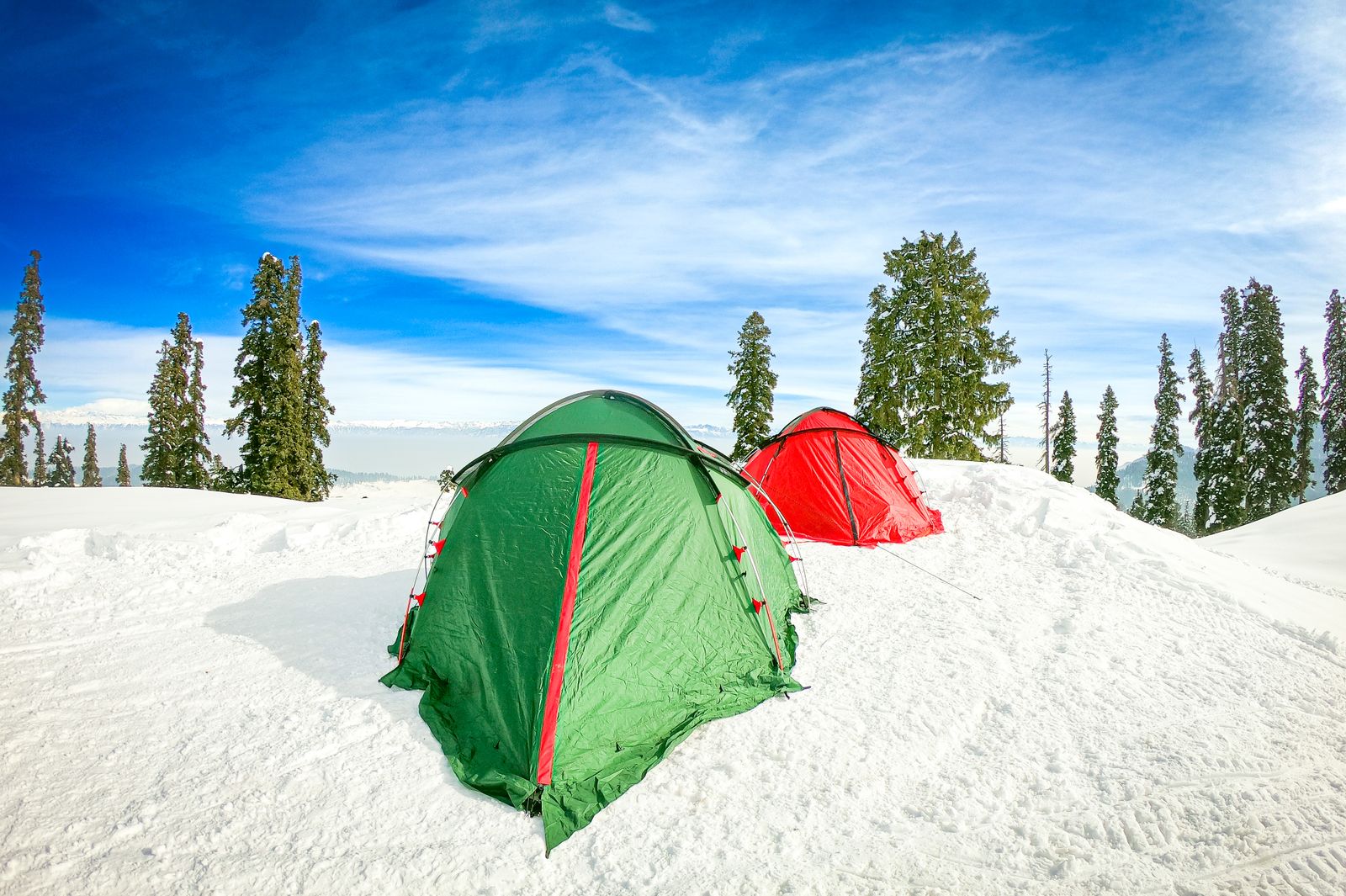
A snow skirt is a strip of fabric round the bottom edge of the flysheet. You lay snow or stones on it, and it closes the gap under the fly, so wind and spindrift cannot get in. On several tents here it folds up for summer, such as the Rock Fortress tipi, and the Northgaze 2.0 has one on all ten sides. Some tents are sold with or without one, so check which version you are choosing.
Less mesh, and the right fabric
A winter inner tent has little mesh or none, which keeps out draughts and holds warmth, and a double layer means the condensation forms on the flysheet rather than on your sleeping bag. The Archeos tent here shows the trade: its 4-season version adds a snow skirt and less mesh, and weighs 3.9kg against 3.5kg for the 3-season one. The guide to single, double and triple layer tents explains the layers. Check the waterproof rating too: the Widesea tent has a 3,000mm flysheet and a 5,000mm floor, while one polycotton hot tent here is rated only 400mm, which suits cold, dry weather better than a wet week. Cotton and polycotton breathe and suffer less from condensation, but they are heavy; see canvas and cotton tents.
Guy points and pegs
Use every guy point: the Rock Fortress comes with 24 pegs and 10 guy lines. The pegs supplied with most tents are made for grass, though. Wide U-shaped aluminium pegs, 23cm and 31cm long, grip snow and sand, and forged steel stakes in 20cm, 30cm and 40cm go into hard ground. Both are in tent pegs, and extra cord is in guy lines.
Staying warm: the ground, the bag and the mat
Most people who are cold in a tent are cold from underneath. This agrees with the 3-season or 4-season guide, which has more on sleeping in the cold.
The ground and the mat
Frozen or snowy ground draws heat out of you faster than the air does, and a sleeping bag gives little warmth underneath, because your weight squashes its filling flat. So the mat matters most. Mats are given an R-value, a measure of how well they stop heat passing through, tested to a standard called ASTM F3340 on most mats sold since about 2020. The higher the number, the warmer the mat, and the R-values of two mats laid together add up. Outdoor retailers usually advise about 4 or more for winter. A closed-cell foam mat under an inflatable one is a common way to get there, and the foam still works if the inflatable punctures.
The sleeping bag
Sleeping bags are given three temperatures, tested to a standard called ISO 23537. The comfort figure is the temperature at which someone who feels the cold should sleep comfortably; the limit figure is the coldest at which someone who sleeps warm should still get a night's sleep; the extreme figure is a survival figure only, never something to plan around. Choose by the comfort figure, and check the forecast for the coldest hour, usually just before dawn.
You
- Change into dry clothes kept only for sleeping, and wear a hat and dry socks.
- Eat a proper meal before bed, cooked outside, and keep a snack for the night.
- A bottle of hot water, closed tightly and wrapped in a sock, warms a bag well, and gives you water that has not frozen by morning.
- Keep batteries in a pocket or the bag. Cold drains them quickly.
What must never be tried is any heater, camping stove or barbecue inside a tent that is not a hot tent made for a stove. They give off carbon monoxide, which has no smell and kills.
Condensation and frost inside
On a cold night you will very likely wake to a wet or frosty flysheet, even in a good tent with no leak. It is condensation. You breathe out a lot of moisture overnight, and that warm, damp air rises to the flysheet, which is as cold as the night outside, and turns back to water on it. Below freezing it turns to frost.
Frost does not drip. The trouble comes in the morning, when the sun reaches the tent or you brush the fly, and it falls as ice or melts. None of this cures it, but it all helps:
- Open the vents, even when it is freezing. Tent makers suggest opening the top of a flysheet door a little too, on the side away from the wind.
- Keep the flysheet tight and off the inner tent. Where they touch, water comes straight through. Tighten the guy lines after dark: nylon stretches as it takes up dew and damp.
- Keep wet coats, boots and gloves in the porch, not in the inner tent.
- Cook outside. A boiling pan puts a great deal of steam into a tent, as well as being a fire and carbon monoxide risk.
- Brush the frost off first thing, before it melts, and keep it off your sleeping bag.
A double layer does not stop condensation; it moves it to the flysheet, where it runs to the ground instead of onto you. A hot tent with its stove lit dries the air, but once the stove goes out the condensation comes back. At home, dry the tent fully before it goes back in its bag, or it will be mouldy by spring.
Hot tents: how a tent stove works
A hot tent is a tent made to be heated by a small wood-burning stove inside it, and the only kind of tent that is ever safe for one. What makes it a hot tent is the stove jack: a ring of fire-resistant fabric in the wall or roof, through which the stove's chimney pipe passes to the outside, so the smoke goes out and the heat stays in. Most also have a snow skirt, vents and flame-resistant fabric. See hot tents with a stove jack.
The stove and its pipe
A tent stove is a small metal firebox with a door. Air comes in through a vent on the door, the wood burns, and the smoke rises up a pipe made of sections that fit together. Many pipes have a damper, a turning plate inside that controls how fast the fire draws: open, the stove burns hotter; closed down, slower. The pipe passes out through the stove jack, and at its top sits a spark arrestor, a mesh cap that stops embers landing on the roof.
A stove jack is a set size, and the pipe has to fit it. The pyramid teepee tent here has a 7cm hole as standard, the large inflatable family tent takes an 11cm pipe, and the OneTigris TEGIMEN hammock tarp has square openings made for its maker's own stove. Measure the pipe, or choose the stove and tent together, and use a stove made for tents.
Which hot tent
- Tipi and pyramid hot tents are the biggest group, with standing height in the middle. The Rock Fortress is 3.8m across and 2.4m high at 4.2kg. See tipi tents.
- Tunnel and dome hot tents put the stove in an extended front hall, away from the bedroom.
- Polycotton hot tents, such as the OneTigris CONIFER and Northgaze TC, are 65% polyester and 35% cotton and fire-retardant.
A stove takes floor space: the Northgaze 2.0 sleeps two with a stove and three without. None of the bell tents here has a stove jack, as the guide to bell tents and glamping explains, and a hole must never be cut in a tent to make one. The stove is for warmth; do the cooking outside, away from the tent.
Stove safety: the stove jack, the clearance, the carbon monoxide alarm
A wood stove in a fabric tent is safe only when all of this is done, every time. Read the tent maker's and the stove maker's instructions first, and follow them where they are stricter.
The stove jack
- Run the pipe out through the stove jack as the maker intended, and nowhere else.
- Keep the flysheet, the inner tent and any guy lines clear of the hot pipe. One maker here says to keep the inner tent away from the side with the chimney opening.
- Fit the spark arrestor, and check it and clear the soot every day the stove is used: a blocked arrestor pushes smoke back into the tent.
- Make sure the pipe sections fit tightly, so smoke cannot leak at the joints. Light a small fire first and look for smoke.
The clearance
- Keep the distance between the stove and the walls that the stove's maker gives. It differs from stove to stove, so use their figure, not a rule of thumb.
- Stand the stove on a fireproof mat, level and steady. Keep bedding, clothes and anything that burns well clear, and never dry clothes on the stove.
- Burn dry wood. A stove burned slowly and cool lines the pipe with tar that can catch fire.
- Flame-retardant fabric is not fireproof. It resists catching light; it does not stop a fire.
The carbon monoxide alarm
- Keep a carbon monoxide alarm inside every time the stove is lit. The Camping and Caravanning Club suggests one tested to BS EN 50291-2, the part of the standard for caravans, boats and camping, and Kitemarked. An alarm is a backstop, never a reason to take risks.
- Keep a vent open whenever the stove is lit. Do not leave a lit stove unattended; stove makers advise against sleeping with it burning.
- Know the signs. The NHS lists headache, dizziness, feeling sick, weakness, tiredness, confusion and shortness of breath. If anyone has them, get everyone outside into fresh air and get help: 999 for trouble breathing, sudden confusion or anyone who will not wake, NHS 111 otherwise.
And for every tent: never take a barbecue into a tent or a porch, lit or gone out, and never charcoal. Never use a gas heater, a camping stove or any stove without a flue inside a tent. Carbon monoxide kills.
Pitching on snow and frozen ground
Ordinary pegs do not hold in snow, and will not go into ground frozen hard. The guide to pitching a tent in wind and rain covers the pitch itself; this is what changes in winter.
Choosing the spot
Look for shelter from the wind, behind a wall or a bank, but not under branches loaded with snow. Keep off steep slopes and away from the foot of them, where snow could slide. Avoid the bottom of a hollow, where cold air collects on a still night. Pitch with the narrow or low end into the wind.
On snow
Before you unpack the tent, stamp out a platform a little bigger than it with your boots, skis or snowshoes, level it, and leave it to firm up; sources give anything from a quarter of an hour to an hour. If you can stand on it without sinking, it is ready. A tent pitched on soft snow sinks unevenly in the night.
For anchors, use wide snow pegs, or make a deadman: a peg, a stick or a small bag filled with snow, tied to the guy line at its middle and buried sideways in a trench across the pull. Pack snow over it, stamp it down and let it set before you tighten the line. In the morning, dig it out rather than pulling on the line. Lay snow on the snow skirt all round, and if snow falls overnight, knock it off the fly from inside before it builds up.
On frozen ground
Thin aluminium pegs bend in frozen ground. Use steel or titanium pegs, the forged steel stakes or the 20cm to 40cm titanium pegs here, and drive them straight down with a mallet. A peg with a cord or ring at the top is far easier to pull out once it has frozen in. Where nothing goes in, tie the line round a large stone, and start pitching before dark.
Ice fishing shelters
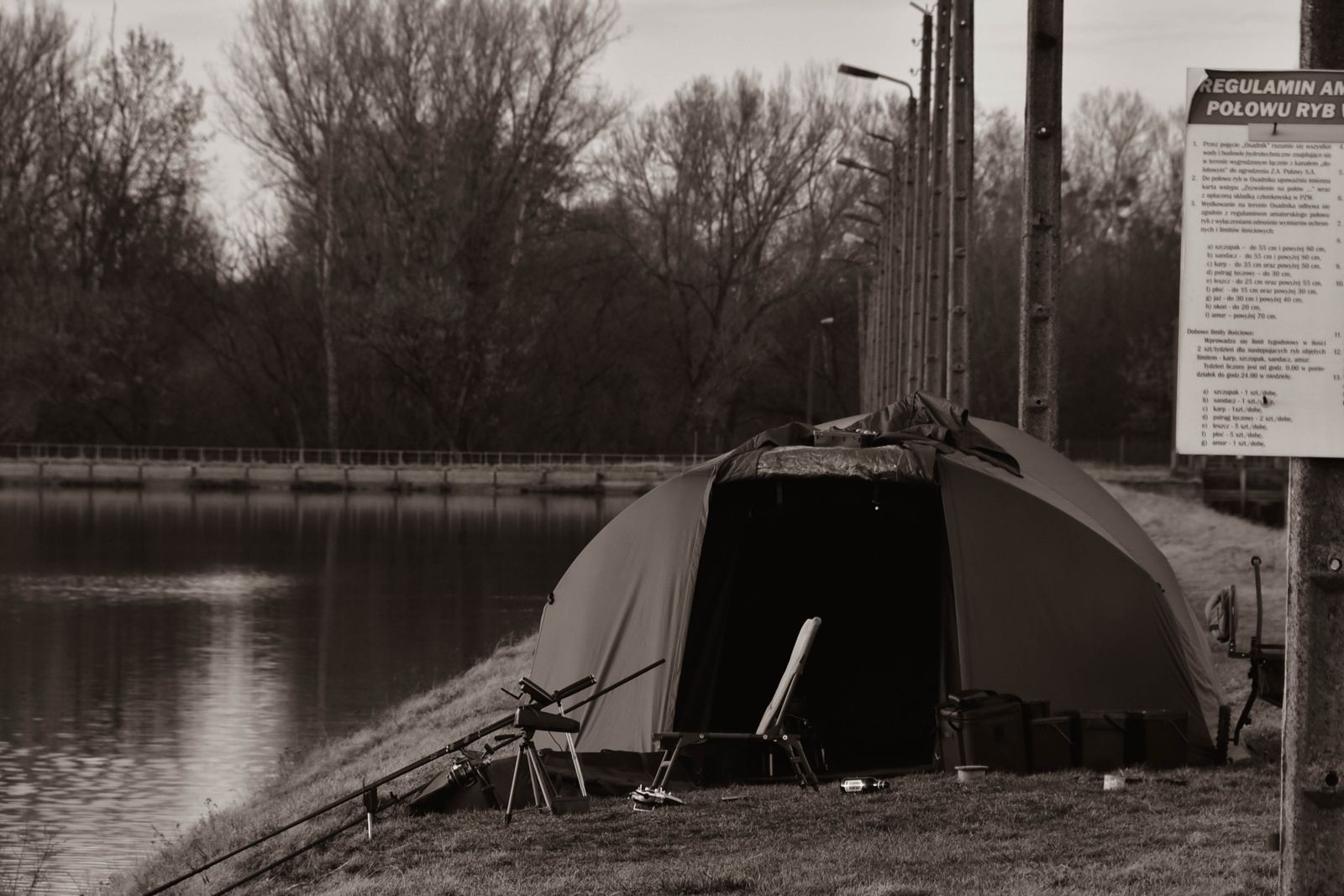
An ice fishing tent is a closed-in shelter to sit in through a cold day's fishing, quick to put up and made to keep the wind off for hours. Abroad they stand on frozen lakes. In Britain the Royal Life Saving Society UK advises never going onto ice under any circumstances, and says ice across the UK and Ireland is unlikely to freeze thick enough to walk on safely. So here they are winter shelters for the bank. See ice fishing tents.
- Pop-up ice fishing tents. Size: 150 by 150cm, 190cm high, for one or two. Frame: steel. Packed: a disc 62 by 62 by 5cm. Weight: about 3kg.
- Thickened Cotton Winter Ice Fishing Tent. Size: 220 by 220cm, 165cm high. Fabric: five layers of cotton and 210D Oxford. Weight: about 13kg.
- Single Winter Fishing Cotton Tent. Size: 1.8m to 2.4m square, for one angler. Fabric: thickened cotton.
- Chimney Winter Fishing Tent. Size: for three or four. Fabric: thickened cotton and flame-retardant Oxford, with a chimney opening. Rating: 1,000mm to 1,500mm.
The pop-ups stop the wind and are easy to carry to a far swim. The padded cotton tents hold warmth far better but weigh several times as much, so they suit a spot near the car; they are also in triple layer tents. Padding does not make a tent more waterproof, and thick cotton dries slowly, so dry it right through at home. The cotton tent comes with four ice nails and four wind ropes, the pop-ups with eight ground nails: use every one. Only the chimney tent is made for a stove, under the same rules as any hot tent; a small closed shelter fills with gas very quickly.
Questions people ask
Can I use my 3-season tent in winter?
On a sheltered campsite in mild, wet weather, yes, with a warm bag and a mat of about R4 or more. For snow, high ground, strong wind or a stove, use a 4-season tent.
Is a hot tent safe to sleep in?
Stove makers advise against sleeping with the stove alight. Let it burn down first, keep a carbon monoxide alarm inside and a vent open, and sleep well away from the stove.
Can I put a stove in any tent?
No. Only in a hot tent with a stove jack, with a stove made for tents whose pipe fits that jack.
Why is my tent wet inside when it has not rained?
Condensation from your breath, which freezes into frost on a cold night. Open the vents and keep the flysheet tight and off the inner.
Which pegs do I need for snow?
Wide U-shaped snow pegs, or deadman anchors buried sideways. For ground frozen hard, steel or titanium pegs.
Where to go next
- Tents for the cold: 4-season tents, winter and snow tents and mountain tents.
- For a stove: hot tents with a stove jack and tipi tents.
- For sitting out a cold day: ice fishing tents, triple layer tents and canvas and cotton tents.
- To hold it down: tent pegs and guy lines.
- Read on: 3-season or 4-season, single, double and triple layer tents, bell tents and glamping and how to pitch a tent.
Delivery is included in every price and tracked to your door.