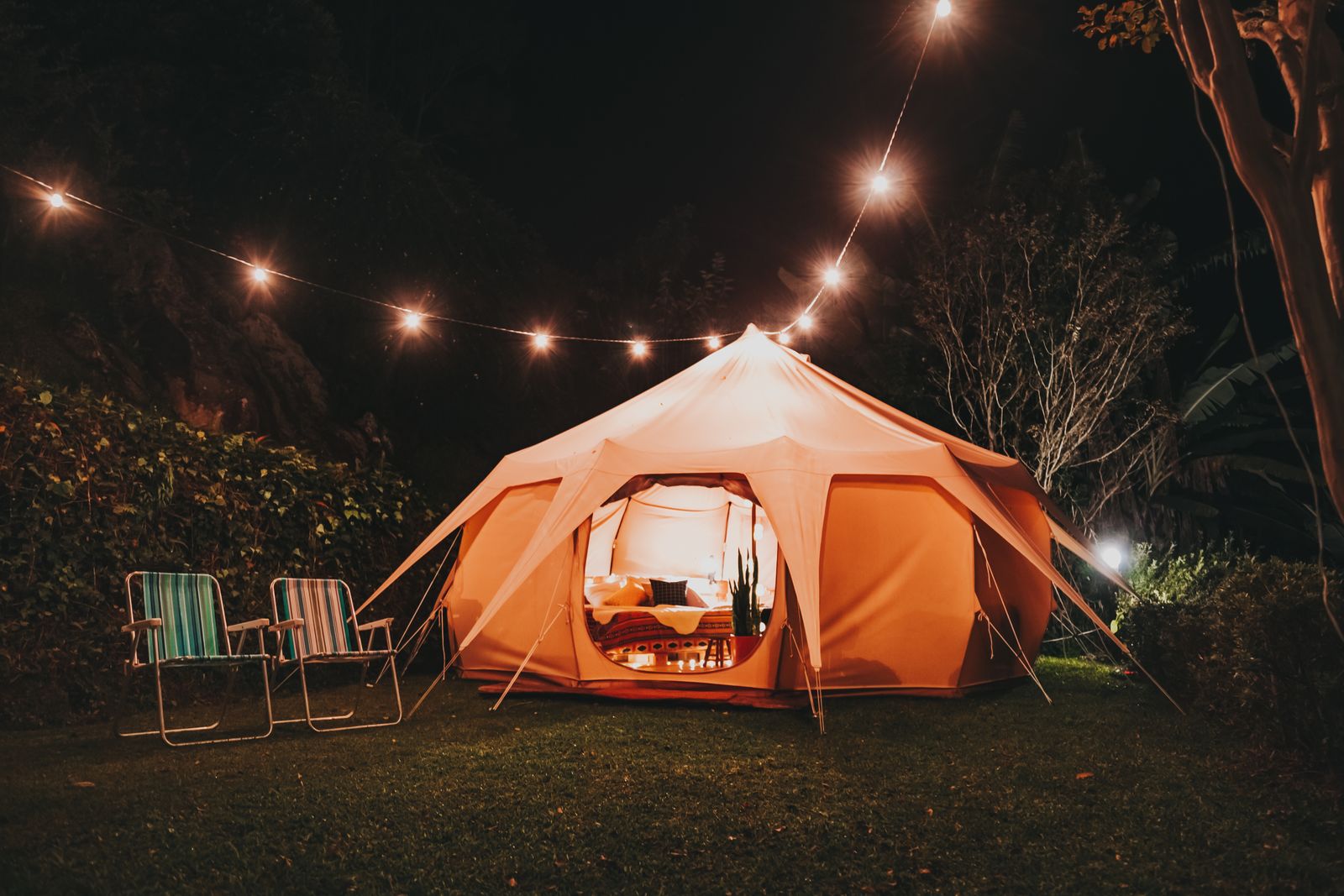
A bell tent is the tent most people picture when they hear the word glamping: round, tall in the middle, canvas glowing in the evening. It is also a proper camping tent with its own habits: heavy, slow to dry and pitched in a different order from a dome or a tunnel. This guide covers what a bell tent is, how many sleep in each size, how canvas, polycotton and Oxford compare, pitching and mould, stoves, and the rest of glamping: safari tents, domes, bubble tents, rugs and lights.
What a bell tent is: one pole, a round floor, canvas walls
A bell tent has a round floor, a low upright wall all the way round, and a roof that rises to a single tall pole in the middle. A smaller pole, often an A-frame, holds up the door. The wall is held out by guy lines pegged all round the tent, and those guy lines are what give it the shape of a bell. There is no inner tent and no flysheet in the usual sense: the canvas is one skin, and inside is one big room.
That shape is the reason people choose it. You can stand up across most of the floor, not only under the peak, and there is room round the edge for real beds, a rug and some furniture. On a summer week it feels more like a room than a tent. The large family bell tent here, for example, is 400 by 400cm and 240cm high at the pole.
The shape has its costs. Canvas is heavy, and the large family bell tent weighs about 20kg. The guy lines go out on every side, so it needs a circle of ground wider than the tent. And canvas has to be dried properly every time.
Bell tents, tipis and yurts
Three round tents are easily confused. A bell tent has its low upright wall. A tipi or pyramid tent has no wall at all: its sides slope straight from the peak to the ground, which makes it lighter for its size but lower at the edges. Many tipis are made in polyester or nylon, and several take a stove. See tipi tents. "Yurt" is a word makers use freely for round tents. Several of the bell tents here are sold as yurts, the same round shape, and two of them stand on a frame instead of hanging from one pole: the Four-Season Oxford Yurt on a steel pole frame, and the Luxury Bell Tent Yurt on a galvanised iron pipe frame. All of them are in bell tents, and the ones best suited to a glamping stay are gathered in glamping bell tents.
Sizes and how many sleep in each
A bell tent is sized by the diameter of its floor: the distance straight across, through the pole. The cotton canvas bell tent here comes at 3m, 4m, 5m and 6m across. Because the floor is round, a small step in diameter makes a big difference to the floor. Worked out from the diameter, the floor areas are roughly these:
- 3m bell tent. Floor: about 7 square metres.
- 4m bell tent. Floor: about 12.5 square metres.
- 5m bell tent. Floor: about 19.5 square metres.
- 6m bell tent. Floor: about 28 square metres.
Not all of that floor has headroom. The wall is low, so the outer ring is where beds and bags go, and the standing room is the middle.
How many people
Bell tent makers' own size guides give figures that vary from one maker to the next, and the higher figures count sleeping bags laid side by side on the floor. With proper beds and room for bags, they come out roughly like this:
- 3m. Comfortable for: one or two. Most on the floor: about four in sleeping bags.
- 4m. Comfortable for: about four. Most on the floor: seven or eight sleeping bags.
- 5m. Comfortable for: about six, some makers say up to eight adults. Most on the floor: around ten.
- 6m. Comfortable for: about eight. Most on the floor: up to about twelve.
The large family bell tent here, 400cm across, is sold for 4 to 10 people, which fits that pattern. The Four-Season Oxford Yurt is sold for 4 to 5, and the Luxury Bell Tent Yurt splits about 7 square metres into a bedroom and a living area.
Choose by the beds, not only the people
In a round tent people usually sleep with their feet towards the pole, like the spokes of a wheel. A regular sleeping mat is about 51cm wide and a wide one about 64cm, while an airbed or camp bed takes more, so plan where the beds you will really bring go. Tent sizes explained has the mat sums. Then think about the ground: the guy lines are pegged at least a metre beyond the wall, as one maker's instructions put it, so a 5m tent needs a clear circle of 7m or more. Check the campsite's pitch size before you book.
Canvas, polycotton or Oxford
Cotton canvas
Cotton canvas is the traditional fabric. The cotton breathes: it lets moisture through, so a canvas tent drips far less condensation than a coated synthetic tent, stays cooler in strong sun and keeps its warmth better at night. Glamping bell tent canvas is commonly 285gsm or 320gsm. The price is weight and care: canvas is heavy, heavier still when damp, slow to dry, and needs a first soaking before it is fully watertight. The large cotton canvas bell tent here is rated PU5000 and comes with a PVC groundsheet; the large family bell tent is described simply as waterproof canvas.
Polycotton
Polycotton, also called TC, is a blend of polyester and cotton, most often about 65% polyester to 35% cotton. It still breathes, a little less than pure cotton, and the polyester makes it lighter, harder wearing and quicker to dry. None of the bell tents here is sold as polycotton. In this shop polycotton is found on the OneTigris CONIFER and Northgaze TC hot tents, and on roof tents and awnings. See canvas and cotton tents.
Oxford fabric
Oxford is a heavy woven synthetic, usually polyester, coated to keep water out. It needs no first soaking, it is lighter than canvas of the same size, and it dries much faster. Because the coating stops water, it also stops your breath, so an Oxford tent needs its door and vents open to keep condensation down. The two Oxford yurts here are 900D Oxford, the thickest fabric in the shop, and both are sold as waterproof and mould-resistant; the Luxury Bell Tent Yurt is rated over 3,000mm on both the outer tent and the groundsheet, with a UV50+ rating. See Oxford fabric tents.
Side by side
- Cotton canvas. Breathes: the most. Weight: the heaviest. First soaking: needed. Drying: the slowest.
- Polycotton. Breathes: nearly as well. Weight: a little lighter. First soaking: often needed. Drying: quicker than cotton.
- Oxford. Breathes: no, so keep it aired. Weight: lighter again. First soaking: not needed. Drying: quick.
The waterproof rating is the hydrostatic head, tested to BS EN ISO 811; about 1,000mm is the lowest figure the trade usually calls waterproof. For why one skin drips more than two, see single, double and triple layer tents, and for each fabric in full, tent fabrics explained.
The first soaking
New cotton canvas, and much polycotton, can let a little water through at the stitch holes until the cotton has swelled. The cure is seasoning: pitch the tent, soak it with a hose, let it dry completely, and repeat two or three times if it still seeps. Read the maker's instructions first, as some come treated. Oxford needs none of this.
Pitching a bell tent, and keeping it taut
A bell tent is far easier to pitch with two people. Choose flat ground, clear of stones, with the door facing away from the wind. Makers' instructions vary, so follow the tent's own; most go roughly like this:
- Lay the groundsheet out and peg it, pulling it tight as you go so the floor has no wrinkles.
- Zip the door shut. Pitching with the door closed keeps the shape even.
- Lay the canvas over the groundsheet with the door lined up with the groundsheet's door, and peg the guy line above the door straight out, in line with the zip.
- Go in through the door with the centre pole, push it up into the peak and stand it upright in the middle of the groundsheet.
- Put up the door pole or A-frame in the doorway.
- Peg the rest of the guy lines evenly all round, at least a metre out from the wall, then tighten them until the walls stand straight with no sagging between them.
- Peg down the loops at the bottom of the wall, and zip or clip the walls to the groundsheet where the tent has them.
A tent this heavy needs good pegs and a mallet. Grooved pegs hold guy lines better than smooth ones, which are kept for the groundsheet. See tent pegs and tent mallets. Put a new tent up in the garden first, which is also the time for the first soaking.
Keeping it taut, in rain and in sun
A bell tent stands by its tension: slack guy lines let the walls sag, and over-tight ones strain the seams. Canvas and cotton guy ropes shrink when wet, so a tent pitched tight on a dry afternoon can be pulled tighter still by a night of rain, enough to pull pegs out. Slacken the guy lines a little when rain sets in, and in heavy mist, and tighten them again when the canvas has dried. Check them through the stay and after strong wind. An Oxford tent changes much less. If the tent looks lopsided, one guy line is usually tighter than the one opposite. See guy lines.
Mould, drying and storing canvas
Canvas lasts for years if it is put away dry, and is spoiled quickly if it is not. Mould grows on damp cotton, shows first as small black or grey spots, marks the canvas for good, and in time the cotton rots. In warm, damp conditions it can begin in as little as a day.
Keeping mould away
- Dry it completely before it is packed for storage: walls, seams, the groundsheet underneath, the guy ropes, the pole bag and the pegs.
- If it comes down wet, fold it loosely for the journey and put it up again at home, or hang it in a garage, until it is dry right through.
- Keep it clean. Sweep out the inside and brush off mud, leaves and grass before packing, because dirt holds damp.
- Air it on site. Pitch where it gets some sun, keep long grass off the walls, and open the door and vents on dry days.
- Store it dry, in a breathable bag rather than plastic. In a damp garage or loft, a dehumidifier helps.
The two Oxford yurts here are sold as mould-resistant, which helps, but dry them before storing all the same.
If mould has started
Let the tent dry first, then brush off what you can outdoors with a soft brush. For light spots, one tent maker suggests a mix of one part white vinegar to four parts water, left on for about 20 minutes and then brushed gently, or you can use a cleaner made for canvas. Never use bleach or household detergent: they weaken canvas and strip its proofing. Mould deep in the fibres may leave a stain that never fully comes out, but cleaning stops it spreading. Dry the tent fully afterwards, and reproof it with a canvas proofer if it has started to let water through.
Stoves in a bell tent: only with a stove jack
A wood-burning stove is safe only in a tent made for it, with a stove jack: a ring of fire-resistant fabric in the wall or roof, through which the stove's chimney pipe passes outside. The jack is a set size, and the pipe has to fit it.
None of the bell tents here has a stove jack, so none of them is for a stove. Do not cut a hole in a tent to make one. If you want a round tent with one tall pole that does take a stove, look at the tipi hot tents in hot tents with a stove jack: the 500PRO tipi is 240cm high at its pole, and the Rock Fortress and the lightweight 6 to 8 person tipi are made for family and group trips.
With a hot tent
- Use a stove made for tents, with a pipe that fits the stove jack, and fit a spark arrestor to the top of the pipe. Check it and clear the soot, because a blocked arrestor pushes smoke back into the tent.
- Keep the clearance between the stove and the walls that the stove's maker gives, stand the stove on a fireproof mat, and keep bedding, clothes and the inner tent well away from it and from the pipe.
- Open a vent whenever the stove is lit.
- Keep a carbon monoxide alarm inside, every time. The Camping and Caravanning Club recommends one tested to BS EN 50291-2, the part of the standard for caravans, boats and camping. Carbon monoxide has no smell, and an alarm is a backstop, never a reason to take risks.
The rules for every tent, bell tents included: never take a barbecue into a tent or a porch, even one that has gone out, and never use charcoal inside or in a porch, because carbon monoxide kills. Never use a heater, or a stove without a flue, inside. Canvas is not fireproof, and a fabric sold as fire-retardant only resists catching light. Do the cooking outside, away from the tent. A tent is no place for a candle or any naked flame either, which is why glamping lights are LED.
Glamping: safari tents, domes, bubbles, and the rugs and lights inside
Glamping is camping with the comforts of a room: a proper bed, a rug and soft lights. A bell tent travels in the car to a campsite, but much of the rest of glamping is for a garden room or a glamping business, put up once and lived in for a season or longer.
Safari tents
A safari tent has upright walls on a frame, with space to stand anywhere inside. The ones here run from the Waterproof Glamping Cabin Tent, polyester canvas on glassfibre poles, which you can take camping, to the Luxury Glamping Pod Cabin on a steel frame and the Two-Storey Safari Lodge in waterproof PVC, with a loft, both made for sites and holiday lets. See glamping safari tents.
Geodesic domes
A geodesic dome is a round frame of triangles, covered in PVC or clear panels, strong for its size and with the whole floor open. The domes here are mostly 4m to 8m across, and more building than tent: one maker rates its PVC cover for 5 to 10 years, wind of 100 to 120km/h and a snow load of 75kg per square metre. Names such as Heavy Snow are colour themes, not weather ratings. See glamping geodesic domes.
Bubble tents
A bubble tent has clear walls, so you can lie in bed and see the sky. Some are clear PVC on fibreglass poles; others are polycarbonate rooms made to stay put. Clear walls warm up fast in sun, fog on a cold night, and let everyone see in. The 4 to 6 person bubble tent here has a removable silver-coated cover, rated PU 2000mm, for shade and rain. See glamping bubble tents.
Before anything stays up
A dome, pod or lodge that stays up for guests, or for most of the year, needs firm, level ground or a base and somewhere that drains, and is likely to need planning permission, so talk to your local council before you order.
Rugs and lights
A rug goes on top of the groundsheet and makes the floor warmer and softer; a footprint goes under the tent. In a bell tent the walls curve in at the edge, so a round or hexagonal rug fits better than a square one. The rugs here run up to 200 by 300cm, and the self-inflating hexagonal mat lines the floor for up to three people. See tent rugs and carpets.
For light, glamping lights has battery string lights, rechargeable lanterns, solar fairy lights and guy-rope lights. The 2 in 1 lantern here is IPX4, protected against splashing, and the solar string lights IP65, fine left out in rain. Solar lights need sun: one maker here says 6 hours of direct sunlight for 8 hours of light, so in winter a lantern you can charge by USB is the safer choice.
Questions people ask
How many people sleep in a 5m bell tent?
About six with beds and room for bags, and some makers say up to eight adults. On the floor in sleeping bags, around ten. Plan by the beds you will really bring.
Do I need to season an Oxford bell tent?
No. Seasoning is for cotton canvas and most polycotton, where the cotton has to swell to close the stitch holes. Oxford is a coated synthetic and is waterproof from new.
Is a bell tent warm in autumn and winter?
Canvas holds its warmth better than a thin synthetic tent, and a rug on the floor makes a real difference. Two of the yurts here are sold as four-season. But a bell tent here cannot take a stove, so warmth comes from good sleeping bags and bedding, never from a heater or barbecue.
Can I leave a bell tent up for weeks?
Yes, if you look after it: air it on dry days, check the guy lines after wind and rain, and keep grass off the walls. Sun weakens every fabric over time. A tent left up for paying guests, or for most of the year, is likely to need planning permission, so ask your council first.
Where to go next
- Bell tents and glamping bell tents: every bell tent and yurt in the shop
- Canvas and cotton tents, for canvas and polycotton tents of every shape
- Hot tents with a stove jack, for a tent that takes a stove
- Tent fabrics explained: canvas, polycotton, Oxford and the rest
- Tent sizes explained: the bed sums, size by size
- Family tents: rooms, layouts and awnings, if a bell tent is not quite the shape you need