A tent's size is the first thing on its label and the easiest thing to get wrong. "4-man" sounds like a promise that four people will be comfortable, and it is not quite that. This guide explains what the number really counts, how much width each person takes, how to read the floor measurements on a product page, and how headroom, bedrooms and porches change what a size means in practice. It ends with the reasons not to simply buy the biggest tent you can.
What "2-man" or "6-man" really measures
The number on a tent's label is the number of sleeping mats that fit side by side on the floor, with nothing else inside. It is a count of beds, made by the maker, in a tent pitched just right. It leaves no room for bags, boots, a cool box or a chair, or for anyone broader than a mat, and it assumes everyone lies still, shoulder to shoulder, all night.
That is why a tent filled to its label is cramped for more than a night or two, and why the usual advice is to buy one size up from the number of people sleeping in it. Two adults are comfortable in a 3-man tent with their bags inside; a family of four is comfortable in a 5-man or 6-man tent.
Many tents give a span rather than one number, such as 2–4, 4–6 or 8–12. The lower figure is usually the comfortable one and the higher figure the most that will fit, often counting children, or counting the living area as sleeping space. The product pages here say so in their own words: the 6-8-12 Person Large Family Camping Tent sleeps 6 to 8 people comfortably, with room for up to 12 in its total living space, and the 500PRO tipi fits 5 adults comfortably, or up to 8 people.
Makers also differ on what floor they count. Some count only the bedroom and leave the living area free. Others count the whole floor. The Large Family Camping Tent with Two Bedrooms and Living Room is sold as S for 5 to 8 people, and its S size is 320 by 220cm overall, bedrooms and living room together. Six regular sleeping mats side by side take 306cm, so on that floor eight is a count for children or a very tight squeeze, and the living room would be full of beds. None of this is a fault in the tent. It is why the number on the label is a starting point, and the measurements are the answer.
The sleeping-mat rule, size by size
The simplest way to check a size is to do the sum yourself. A regular sleeping mat is about 183cm long and 51cm wide, and a wide one about 64cm. Long mats are about 193cm to 198cm. Measure your own mats or airbeds if you already have them, because they vary, then add up the widths and compare the total with the width of the inner tent on the product page.
- 1 person. Regular mats (51cm): 51cm. Wide mats (64cm): 64cm.
- 2 people. Regular mats (51cm): 102cm. Wide mats (64cm): 128cm.
- 3 people. Regular mats (51cm): 153cm. Wide mats (64cm): 192cm.
- 4 people. Regular mats (51cm): 204cm. Wide mats (64cm): 256cm.
- 5 people. Regular mats (51cm): 255cm. Wide mats (64cm): 320cm.
- 6 people. Regular mats (51cm): 306cm. Wide mats (64cm): 384cm.
- 8 people. Regular mats (51cm): 408cm. Wide mats (64cm): 512cm.
Whatever is left over after the mats is the room for bags and elbows. Here is how that works out on tents in the shop, size by size.
1 and 2 person tents
The one-person Naturehike Mongar UL has an inner tent 210cm long and 80cm wide. One regular mat takes 51cm of that, leaving a strip beside you for a few small things, with the rucksack in the porch. The two-person Mongar UL is 130cm wide inside: two regular mats take 102cm, leaving a little under 30cm, and two wide mats would fill it. The two-person backpacking tent with aluminium poles is 140cm wide inside, a little more generous. These are typical of light tents, and they show why a lone walker who wants the rucksack inside on a wet night often carries a light 2-man tent rather than a 1-man. See 1-man tents and 2-man tents.
Some small tents are narrower at the feet than at the head. The Naturehike Star Trails EXT one-person inner is 100cm wide at one end and 80cm at the other, which saves weight where your feet need less room. A product page that gives two widths, such as 100/80, is describing a tapered floor.
3 and 4 person tents
The Archeos 3-person tent has an inner 215 by 215cm. Three regular mats take 153cm, leaving about 60cm for bags, which is why many couples choose a 3-man tent. The Fengyin 4-person pyramid, with its 4-person inner, is 230 by 230cm inside: four regular mats take 204cm, leaving 26cm, so four adults fit with bags in the porch. The Qingkong 4-person tent is 230 by 210cm, and there four regular mats take 204cm of the 210cm, with nothing to spare.
A span can hide a narrow inner. The Naturehike Dune 7.6 is sold as a 2–4 person tent, and its inner tent is 220 by 150cm. That takes two regular mats with room to spare, or two wide ones; three regular mats would need 153cm. The rest of the tent is a hall to live in. It is a very comfortable tent for two, and a squeeze for more. See 3-man tents and 4-man tents.
5 and 6 person tents
The connectable MOT-Q500 air tent, for 3 to 5 people, is 265 by 265cm inside. Five regular mats take 255cm, leaving 10cm, so five fit only shoulder to shoulder, and three or four have room to live. The large size of the hexagonal pop-up family tent for 3 to 6 people is 280 by 240cm: five regular mats take 255cm, and a sixth would need 306cm. A six-sided tent also narrows towards its ends, so measure the beds against the straight middle of the floor. See 5-man tents and 6-man tents.
8 person and larger tents
At this size the floor is nearly always split into bedrooms and a living room, so the sum is done room by room. The 3-pole LanSheng tunnel tent, with two bedrooms and one hall, is 520 by 340cm and about 17.6 square metres; the 4-pole version is 680cm long and about 23.1 square metres. The one-touch family dome for 6 to 8 is 400 by 400cm, 16 square metres of covered space. The large size of the two-bedroom family tent, for 8 to 12 people, is 430 by 305cm. The largest inflatable cabin tent here, for 8 to 10 people, is 420 by 513cm. Round bell tents work differently again: the large family bell tent is 400cm across, for 4 to 10 people, with beds round the edge and the middle left for standing. See 8-man tents, 10-man and larger tents and family tents.
Reading the floor measurements on a product page, and tall sleepers
A product page may give three sets of figures, and it pays to know which is which.
- The outer tent or open size is the whole tent on the ground, porch and all. It is the figure to use for fitting the tent on a pitch.
- The inner tent is the room you sleep in. It is the figure to use for fitting the beds. On the Naturehike Dune 7.6 the outer is 320 by 240cm and the inner 220 by 150cm; the difference is the hall.
- The area in square metres is the floor, sometimes with the porch counted in, as on the Naturehike Village 6.0, which gives up to 15 square metres including its vestibule.
Figures are usually given as length by width by height, but not always in that order, so check which is the height before you work out the beds. Measurements are of the floor at ground level, on a tent pitched tight, and real tents vary a little: the two-bedroom family tent's maker notes that its pitched size may differ by 5 to 10cm from the stated one.
If you are tall
Length matters as much as width. A tent's walls slope in towards the top, so the floor measurement is longer than the space at the height where your head and feet actually are, on a mat and inside a sleeping bag. A common rule of thumb for walkers is to look for a sleeping length of your height plus about 13cm to 15cm, measured about a foot above the floor, to leave room for the sleeping bag's filling and for your feet, which point up.
Most of the small tents here have an inner 210cm long. By that rule a sleeper about 183cm tall (six foot) needs around 196cm to 198cm, which a 210cm inner gives, while someone 193cm tall (six foot four) needs around 206cm to 208cm, right at the limit. Taller people should look for a longer inner: the Archeos is 215cm, the Dune 7.6 220cm and the Fengyin pyramid's inners 230cm. If your feet push the inner tent against the flysheet, the end of your sleeping bag will get damp from condensation, which is the first sign a tent is too short.
Headroom and standing height
The height on a product page is the highest point, and in most tents that is only in the middle. A dome, a tipi or a pyramid slopes away from its peak on every side; a tunnel tent keeps its height along its length but slopes at the sides; a cabin tent has upright walls, so the height carries much further across the floor.
Roughly, the heights in the shop fall into three groups:
- Sitting up: light backpacking tents are about a metre high at the peak. The Mongar UL is 100cm to 105cm inside, and the Archeos 120cm. You can sit up in the middle, change and pack, but not kneel upright. The Naturehike Hillock6 is 125cm: in a tent that height you sit.
- Stooping: many family pole and air tents are between about 160cm and 180cm. The BASTION 4-person family tent gives 165cm of internal height, and the Dune 7.6 is 180cm at its highest point. Many adults can stand in the middle, and taller ones will stoop.
- Standing: big family tents and tipis. The two-bedroom family tents here are 195cm to 210cm high, and the 500PRO and Rock Fortress tipis and the large family bell tent 240cm at the pole.
Two things to check. The inner tent is lower than the outer: on the Dune 7.6 the outer is 180cm high and the inner 160cm, and on the Fengyin pyramid 160cm and 150cm. And standing height matters most where you dress and pack, which on a family tent is the living area. Measure it against the tallest person who will use the tent, not the average.
Bedrooms, living space and porches
Once you go past two or three people, the shape of the floor matters as much as its size.
Porches
A porch, or vestibule, is the covered space at the door, outside the room you sleep in. Boots, wet coats and rucksacks go there, so the sleeping area stays dry and clean. On small tents it is measured in fractions of a square metre: the Mongar UL's hall is about 0.6 square metres on the one-person tent and 1.21 on the two-person, which has a door and a hall on each side so neither person climbs over the other. Most small porches have no floor. See tents with a porch.
One bedroom and a living area
A tent with one bedroom and a living area has an inner tent to sleep in and a covered space beside or in front of it to sit, eat and keep bags. Makers call it a living room, a hall or a vestibule, and "one room one hall" means the same thing. It suits a couple or a small family on a trip of more than a night. Read the inner tent's size to see how much is bedroom and how much is hall. See one bedroom and living room tents.
Two bedrooms and a living room
Two separate bedrooms, usually either side of a shared living room or behind it, let adults and children sleep apart and go to bed at different times. The 10 Person Instant Cabin Tent here has two bedrooms off a central screen room; the LanSheng tunnel has a bedroom at each end of its hall. Check whether the living room has a floor of its own, and how the bedrooms close. See two bedroom and living room tents and two and three room tents.
Room for a family, a dog and the kit
A family tent has to hold more than beds. For a week away, plan the floor before you choose the size.
- Beds: one mat or airbed each, measured as above. Children grow quickly, and a tent bought for small children may be bought for their teenage years too.
- Bags: one bag each, kept out of the beds. In a bedroom tent they go along the walls; in a small tent they go in the porch.
- The living area: chairs, a table, the cool box and somewhere to sit when it rains. This is the space that makes a wet day bearable, and the one the number on the label leaves out.
- Wet things: boots and coats in the porch, never on the bedroom floor.
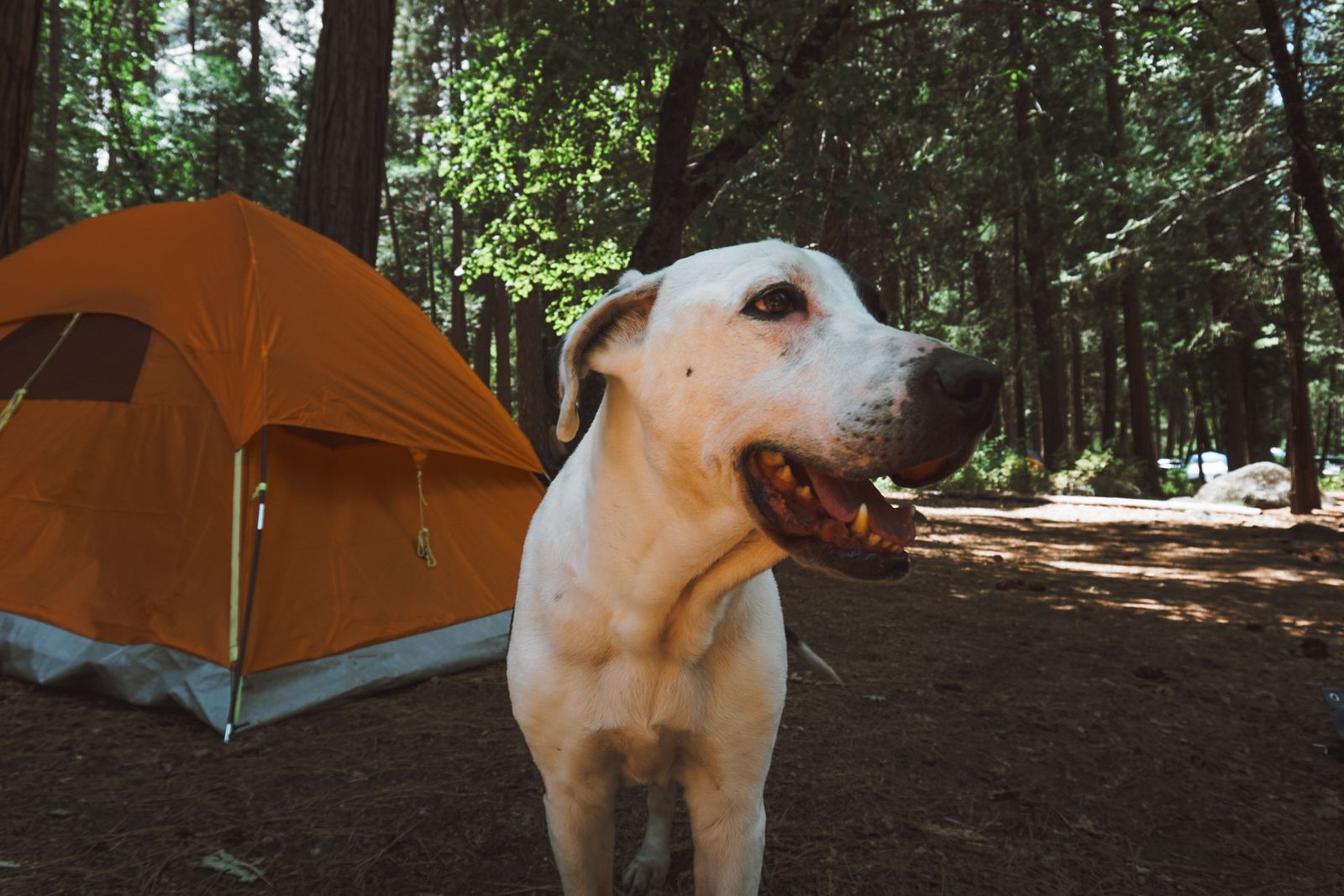
- A dog: a dog needs its own place to lie, in the living area or the porch rather than on the beds, and a big dog takes about the floor of another person. Claws are hard on mesh and thin groundsheets, so a bed or blanket of its own helps. A tent in full sun heats up quickly, so never leave a dog shut in one on a warm day.
Worked through, a family of four with a dog, staying a week, wants four beds, four bags, chairs and a cool box, and a place for the dog. That is a 6-man tent with a living area, or a tent with two bedrooms, rather than the 4-man tent the number alone suggests. A tent carpet in the living area makes it warmer underfoot. See tent rugs and carpets.
Why bigger isn't always better: weight, pitch space, warmth
One size up is good advice. Three sizes up usually is not, for four reasons.
Weight and packed size
Every extra metre of floor is more fabric, longer poles and more pegs. Among the tents here, a two-person backpacking tent can weigh well under 2kg, the BASTION 4-person family tent weighs 6.0kg, the one-touch family dome about 12.7kg and the large inflatable cabin tent 95kg. Carried, that difference decides the trip. In the car, it decides how much else fits in the boot.
Pitch space
Campsite pitches have a size, and a big tent needs room round it for its guy lines as well as its floor. The 4-pole LanSheng is 680cm long before the guy lines are pegged out, and comes with 14 of them. Check the campsite's pitch size before you book, and on a small pitch or a wild camp, a smaller tent is the one that fits. A bigger tent also catches more wind, so it needs every peg in and every guy line tight.
Warmth
A tent is warmed by the people inside it. Two people in a 2-man or 3-man tent warm the air around them; two people in an 8-man tent warm very little of it, and on a cold night a big, half-empty tent feels it. For spring, autumn and winter trips, a tent close to your real size is a warmer tent.
Pitching time
A big tent takes longer to put up and longer to take down, and more people to do it. In rain or in the dark that matters. Air tents and instant tents help at the big end.
Questions people ask
What size tent do two adults need?
A 3-man tent for comfort, with both bags inside. If you are carrying it, a 2-man tent with a porch on each side saves weight.
What size tent does a family of four need?
A 5-man or 6-man tent, ideally with a living area. A 4-man tent will sleep four, but leaves no room for bags or for sitting when it rains.
Does the number include the porch or living area?
Sometimes. Some makers count the bedroom alone, others the whole floor. Compare the inner tent's size with the outer tent's to see which.
Will a double airbed fit in a 2-man tent?
Measure the airbed and compare it with the inner tent's width and length. The two-person Mongar UL is 130cm wide inside and the two-person backpacking tent with aluminium poles 140cm, so check before you buy rather than after.
Should one person buy a 1-man or a 2-man tent?
A 1-man tent is lighter. A 2-man tent weighs a little more and gives room for the rucksack inside on a wet night and space to sit and change.
Where to go next
Every size has its own range, each with the tents filed by the number of people they sleep: 1-man, 2-man, 3-man, 4-man, 5-man, 6-man, 8-man and 10-man and larger, with family tents for everything from four people up. For the other parts of the choice:
- How to choose a tent: the whole choice, from the trip to the tent
- Tent waterproof ratings explained: what the millimetre figures mean
- Single, double and triple layer tents: condensation, warmth and weight