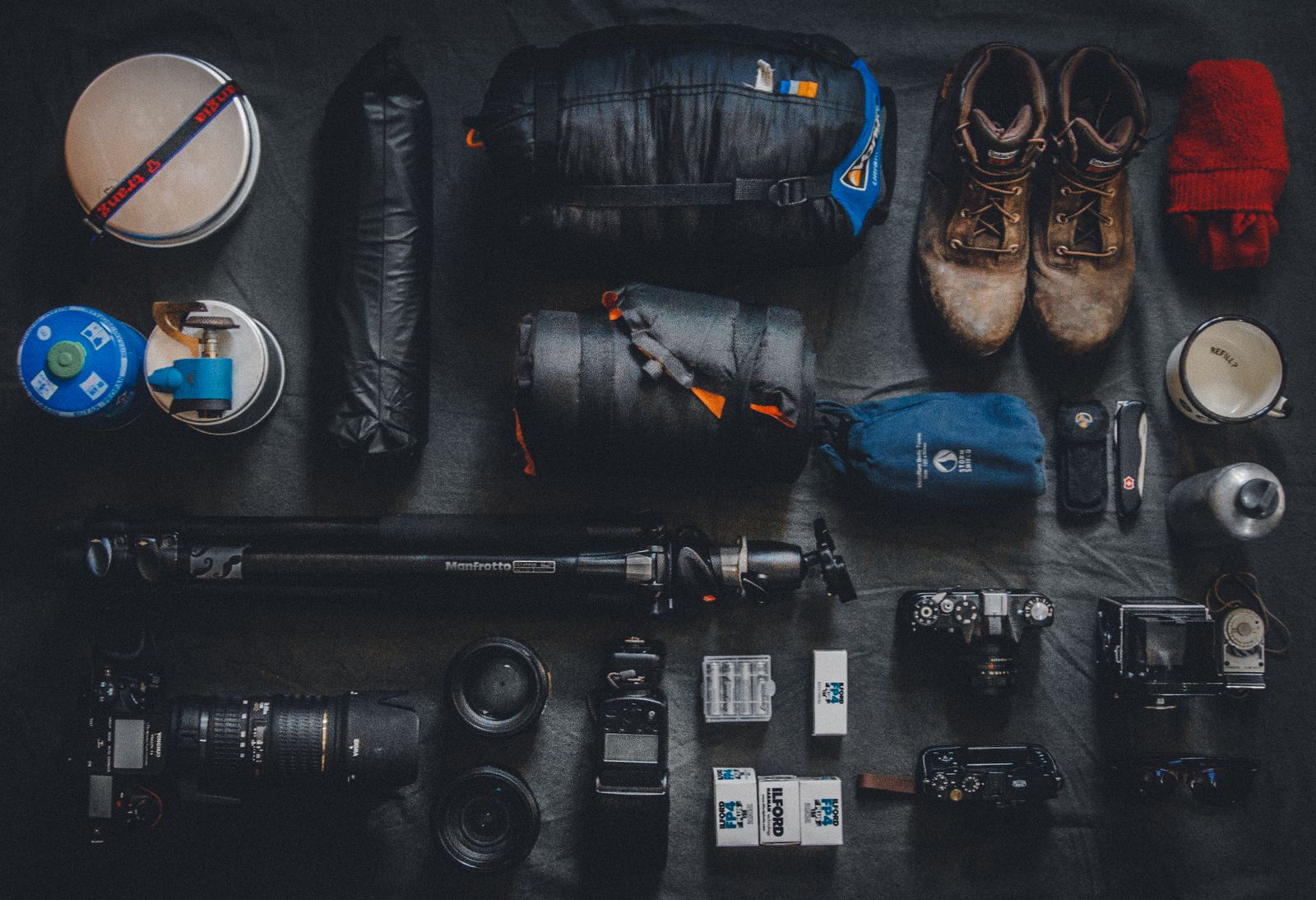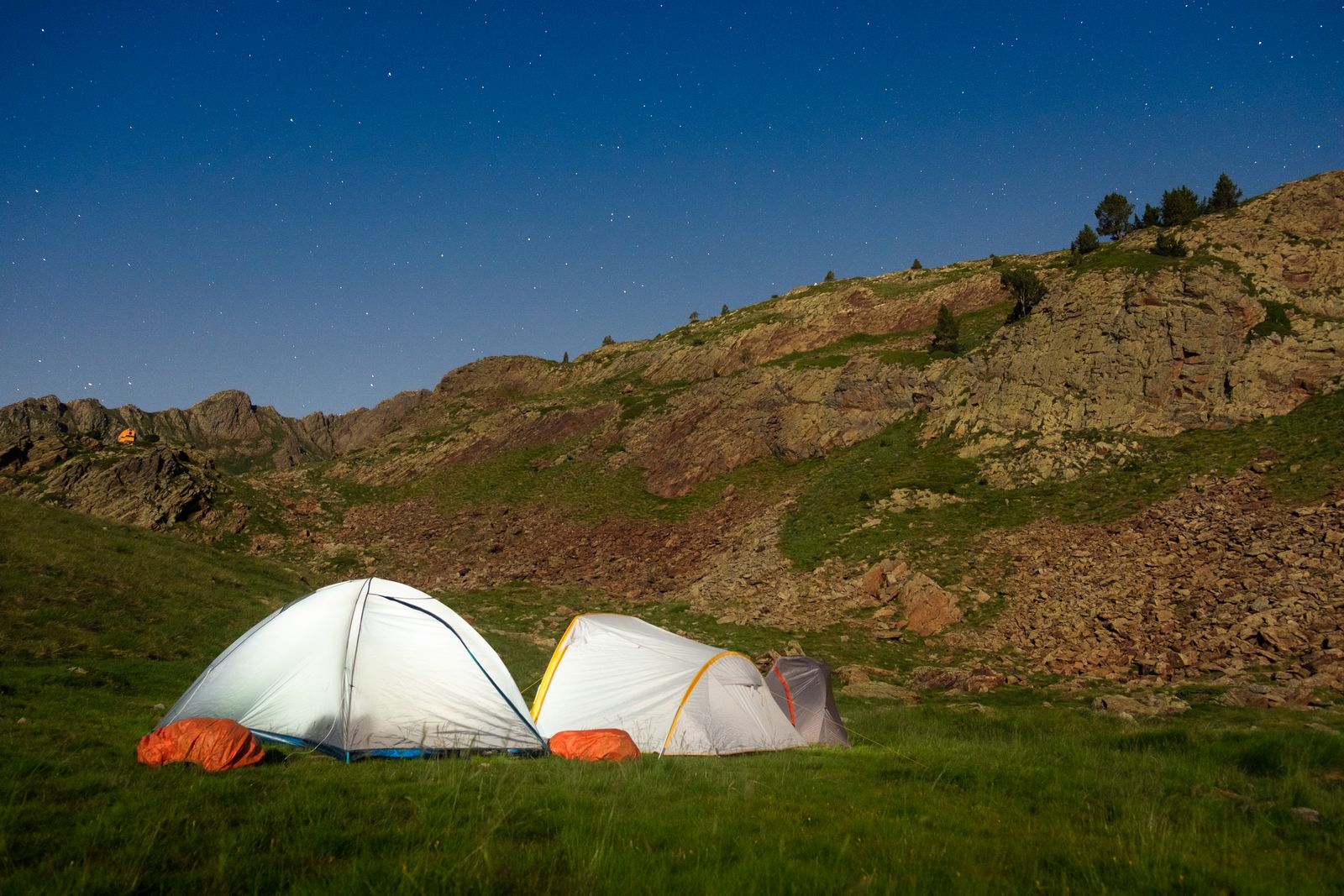
A backpacking tent is the one you carry, with everything else you need, from one night's pitch to the next. That one fact changes how you choose it. Room to stand up and a big porch matter less than they do on a campsite beside the car, and weight, packed size and how the tent copes with an exposed pitch matter far more. This guide explains what sets a backpacking tent apart, how to read the weights and sizes on a product page, the two ways these tents stand up, single and double wall, pitching in wind and rain, and how to camp away from a campsite without leaving a mark.
The tents made for several days on foot are in backpacking and trekking tents, and the small, light tents for a night out on a walk are in hiking tents. Many tents are in both, because the same light tent does both jobs.
What makes a tent a backpacking tent
Three things, and they pull against each other. It has to be light enough to carry all day on top of your sleeping bag, mat, food, water and spare clothes. It has to pack small enough to go inside or on your rucksack. And it has to keep you dry and standing on the third night, in whatever weather arrives, because you cannot drive home if it goes wrong. The tent is one of the three heaviest things in most rucksacks, with the sleeping bag and the mat, so it is where most people start when they try to carry less.
Who it is for
Most backpacking tents are for one or two people, and that is true of the tents here: the biggest groups are 1-man tents and 2-man tents. A few are made for three, such as the Archeos 3P and the three-person Naturehike Opalus tunnel tent, and one, the Qingkong, is a light double-layer tent for four. Remember that the number on the label is the number of sleeping mats that fit side by side with nothing else inside, so a light 2-man tent is a comfortable size for one walker who wants the rucksack inside on a wet night.
What it gives up
Light tents save weight in ways you can see. They are low: the one-person Mongar UL is 105cm high and the two-person 110cm, which is room to sit up but not to kneel upright. The porch is small, big enough for boots and a rucksack rather than a chair. The fabric is thin, often 10D to 20D nylon, so it needs pitching away from thorns and sharp stones and handling with a little care. That matters little on a long walk, and a lot on a week's campsite holiday.
The shapes you will see
- Small domes, such as the Mongar UL and the OneTigris Stella, on poles that cross over the top.
- Tunnels, such as the Opalus and the Taihang 2MAX: a lot of room for their weight, pegged out at both ends.
- Pyramids and A-frames on one or two walking poles. See pyramid tents.
- Light hot tents for winter treks, such as the Northgaze 2.0 pyramid at about 2.8kg.
Most of the backpacking tents here are double layer and made of nylon or polyester, and of those that name their poles, most stand on aluminium or aluminium alloy, the strongest pole for its weight. The Naturehike Taga, for example, uses 7001 aluminium alloy poles. See aluminium alloy pole tents, and the guide to tent poles for why alloy suits a tent you carry.
Weight: what the figures on a product page mean
Weight is the figure most people compare first, and it is the easiest one to misread, because makers do not all weigh the same things. You will meet three kinds of figure.
- Minimum weight, sometimes called trail weight. This is the tent itself: the inner, the flysheet and the poles. It leaves out the pegs, the guy lines and the bags.
- Packed or packing weight. This is everything that comes in the box, bags and pegs included, and it is closer to what you will actually carry.
- Plain "weight" or "net weight". This could be either, so read the words next to it, such as "excluding footprint" or "floor mat and nails excluded".
There is no industry rule for what goes into each figure, so the safest way to compare two tents is to compare the same kind of figure on both. The tents here show how wide the gap can be.
- Naturehike Star Trails EXT, 1 person. Minimum weight: about 0.78kg. Packed weight: about 0.87kg.
- Naturehike Mongar UL, 1 person. Minimum weight: about 1.20kg. Packing weight: about 1.34kg.
- Naturehike Mongar UL, 2 person. Minimum weight: about 1.53kg. Packing weight: about 1.67kg.
- Taiji 1. Inner and outer tent: 1,450g. Total, with poles, pegs, guy lines and footprint: 1,870g.
- Taiji 2-Person. Inner and outer tent: 1,760g. Total: 2,000g.
On the Naturehike tents the packed weight is about 90g to 140g more than the minimum. On the Taiji tents the total is 240g to 420g more than the tent alone, because it counts the poles, pegs and a footprint.
The footprint and the extras
A footprint is a sheet under the tent that protects a thin floor from stones and grit. Some tents here include one, such as the Taiji 1 and the Taiji 2-Person, and many give their weight "excluding footprint", like the Giling PRO, at about 1.45kg for the single and 1.77kg for the double. If you want one and it is not in the box, add its weight to the tent's. The light footprints in groundsheets and footprints run from a 165g sheet of 15D silnylon, 210 by 130cm, down to a 67g Polycro sheet.
What a few hundred grams buys
A lighter tent usually means thinner fabric, a lower roof and a smaller porch; a heavier one is often tougher, roomier or built for winter. The Archeos 3P weighs 3.5kg as a 3-season tent and 3.9kg as a 4-season tent, and the extra 400g is a snow skirt and less mesh in the inner. A tent pitched on walking poles weighs less again, because it has no poles of its own, but that saving is real only if you walk with poles anyway.
Packed size, and splitting the load between two
Packed size decides where the tent goes on you. A tent about 40cm long fits across the bottom of most rucksacks or down a side pocket; a longer one usually straps on the outside. What sets the length is the pole sections, because the fabric squashes and the poles do not. Some figures from the tents here:
- Naturehike Taga and Tagar. Packed size: 10 by 40cm.
- Naturehike Mongar UL. Packed size: 14cm across and 40cm long for one person, 15 by 41cm for two.
- Naturehike Star Trails EXT. Packed size: 13 by 45cm for one person, 14 by 46cm for two.
- Archeos 3P. Packed size: 17.5 by 17.5 by 47cm.
- Naturehike Opalus, 3 person. Packed size: 55cm long and 17.5cm across.
Pack the pegs in their own bag so they cannot rub a hole in the fabric, and keep the flysheet where you can reach it first if it is raining when you stop. On a bike, length matters more than weight, so check the packed length against your bags or rack. See bike and bikepacking tents.
Two walkers, one tent
Two people walking together can share one tent: one carries the inner and the flysheet, the other the poles, the pegs and the footprint. Two one-person Mongar UL tents weigh about 1.34kg each, 2.68kg between you; one two-person Mongar UL weighs about 1.67kg, well under 1kg each. Two tents give each of you your own space; one saves weight and is warmer, with two of you inside. If you share, a tent with a door on each side saves climbing over each other in the night.
Freestanding or trekking-pole tents
Backpacking tents stand up in one of two ways, and it is worth choosing between them on purpose.
Freestanding tents
A freestanding tent holds its own shape with its poles. Most small domes are like this: once the poles are in, the tent stands before a single peg goes in. You can put it up on hard or stony ground, pick it up to shake out grit or turn the door away from the wind, and move it if you find a lump under the floor. It still needs pegging: an empty dome is light and will roll away in a gust. The OneTigris Stella is a light dome of this kind, about 1.9kg for one person and 2.2kg for two. Tunnel tents are not freestanding: they need pegging out at both ends before they stand.
Trekking-pole tents
A trekking-pole tent comes with no poles. You pitch it on the walking poles you carry anyway, so you carry one set instead of two. The Ultralight Single Person Tent here, a double-layer tent in 15D silicone-coated fabric, weighs about 800g in all because of it.
- The Single Layer Pyramid Camping Tent is, in its maker's word, non-freestanding. It stands on one 135cm trekking pole or two 160cm poles, and the maker sells extension poles for shorter ones.
- The Ultralight 1-2 Person Trekking Pole Backpacking Tent is an A-frame on two poles at about 1.25m, or it can be hung from a branch.
- Several pyramids are sold in parts: a flysheet from 410g for one person, with a mesh inner from 230g.
Three things to know before you buy one. Check that your poles reach the length the maker gives, because a pole too short leaves the tent sagging. The tent only stands once it is pegged out, so it needs ground that takes pegs; on thin soil over rock, tie the lines round heavy stones. And if you want to walk up a hill from camp with your poles, the tent comes down first.
Which to choose
If you walk with poles, count every gram and mostly camp on grass, a trekking-pole tent is the lightest way to sleep under cover. If you camp on stony ground, want the simplest pitch, or do not use walking poles, a freestanding dome is easier to live with.
Single or double wall on the hill
On a walk, layers matter in the same way as anywhere else, with one difference: you cannot go home to dry out. The guide to single, double and triple layer tents covers the subject in full, so this is the short version for a tent you carry.
Double wall
A double-wall tent, called double layer here, has a breathable inner tent under a waterproof flysheet. The moisture you breathe out passes through the inner and settles on the flysheet, not on your sleeping bag, and the flysheet makes the porch. Most of the backpacking tents here are built this way, and it is the safer choice for most of the year in Britain, because a damp sleeping bag on the second night is much worse than one heavy pack. Several let you choose the inner. The TAIJI2 has a 3-season inner of 20D net, which weighs 512g, or a 4-season inner of 210T nylon; mesh is cooler in summer, solid nylon warmer and less draughty in spring and autumn. See double layer tents.
In rain, ask how the tent goes up. A tent that pitches the flysheet first, or both layers together, keeps the inner dry while you pitch. Many pyramids pitch the flysheet first and clip the inner in afterwards, which suits British weather well.
Single wall
A single-wall tent is one waterproof skin, quicker to pitch and, against a tent built the same way, lighter: the Single Layer Pyramid's flysheet weighs 454g. The cost is condensation: on a cold, still night the inside of the one skin gets wet and brushes off on you, so open every vent and keep your kit off the walls. And the lightest double-layer tents here, in 10D nylon, weigh less than several single-layer ones.
The fabric
Most light tents are nylon, the lightest strong tent fabric. It stretches a little when wet, so tighten the guy lines once rain or dew arrives. See nylon tents, and the guide to tent fabrics for what 10D and 20D mean.
Wind, rain and the pitch you find
On a campsite somebody has chosen the flat ground for you. On a walk, the pitch is whatever you find at the end of the day, often when you are tired and the light is going. A few minutes spent choosing it is the best weather protection there is.
Choosing the spot
- Look for ground that is flat and slightly raised, so rain runs away from you rather than under you.
- Avoid hollows and dips. Water collects there after rain, and cold, damp air settles there overnight, which means more condensation.
- Avoid the very top of a ridge, where the wind is strongest. A spot sheltered by a wall, a bank or a large boulder is far kinder.
- Stay back from streams and rivers, which can rise quickly after rain upstream.
- Clear stones and sticks from the patch before the floor goes down.
Pitching for wind
Pitch with the narrow or low end into the wind, and keep the door on the sheltered side, so the wind cannot get under the flysheet and rain does not blow in each time you open it. Peg out every guy line, even on a calm evening, because the weather can change after dark. Push each peg in at a slight angle, leaning away from the tent, and on thin or stony ground weigh the line down with a heavy stone where a peg will not hold. Light pegs save weight but bend in hard ground, so carry a few spares; the lightest here is a carbon fibre peg that weighs 3.7g. See tent pegs.
Low tents shed wind best, which is why tents made for high ground are about a metre tall: the Giling PRO, a 4-season tent, is 105cm to 110cm high. See mountain tents, and 4-season tents for tents with a snow skirt and stronger poles for winter.
Rain, cooking and a roof to sit under
Cook outside, away from the tent, even in rain, never in the porch: a stove can set a tent alight in moments and gives off carbon monoxide. A light tarp gives you somewhere dry to sit outside the tent on a wet evening; the lightest here weigh about 160g. Keep stoves well clear of a tarp too. See tarps and tarp shelters. And carry an emergency bivvy bag in case you are caught out before you reach your pitch: the smallest here weighs 110g. See survival bivvy bags.
Wild camping and leaving no trace
Many people buy a backpacking tent to camp away from campsites, on a hillside or by a lake. Whether you may do that depends on where you are and who owns the land, so check before you go, and ask the landowner's permission wherever it is needed. Whatever the place, the way to do it well is the same: arrive late, leave early, and leave nothing behind.
Pitch late, leave early
Put the tent up in the evening and take it down early the next morning, so it stands for as short a time as possible. Keep the group small, pitch out of sight of houses, roads and paths, keep away from crops and animals, and move on the next day.
The Leave No Trace principles
The Leave No Trace Center for Outdoor Ethics publishes seven principles that many walking and outdoor groups use. In short, with what each one means for a night in a tent:
- Plan ahead and prepare. Know where you are going and what the weather will do.
- Travel and camp on durable surfaces. Pitch on ground that will recover, and never dig trenches round the tent.
- Dispose of waste properly. Carry out everything you carried in, food scraps included.
- Leave what you find. Put back any stones you moved to clear the pitch.
- Minimise campfire impacts. Cook on a stove, on bare ground or a stone, rather than lighting a fire.
- Respect wildlife. Watch animals from a distance and keep food packed away.
- Be considerate of other visitors. Keep noise down, and pitch away from other people's paths and views.
Toilets
The advice from Mountaineering Scotland, among others, is to go at least 30 metres from any stream, river or loch, well away from paths, and dig a hole about 15cm deep, then fill it in. A small trowel makes this much easier. Carry used toilet paper and sanitary items out in a sealed bag, because they take a long time to break down and animals dig them up.
Before you leave in the morning, walk round the pitch once. Count the pegs back into their bag, pick up anything dropped, and fluff up the flattened grass. The best wild camp is one nobody can tell was there.
Questions people ask
Is a 1-person or 2-person tent better for backpacking alone?
A 1-person tent is lighter. A light 2-person tent weighs a little more and gives room for your rucksack inside on a wet night: the Star Trails EXT is about 0.87kg packed for one person and 1.05kg for two, a difference of under 200g.
Do I need a footprint under a light tent?
It is not essential, but the floors of light tents are thin, and a footprint protects them from stones and grit and is far cheaper to replace than the tent. Make sure it is a little smaller than the tent's floor, so it does not catch rain and run it underneath you.
My walking poles are shorter than the tent needs. Can I still use it?
Not well, because a pole that is too short leaves the fabric slack. Check the length the maker gives against your poles at full stretch. Some makers sell extension poles for this, as the maker of the Single Layer Pyramid Camping Tent does, or you can buy a separate support pole.
Can I use a backpacking tent in winter?
Choose a 4-season tent, with a snow skirt, stronger poles and less mesh, such as the 4-season version of the Archeos 3P. For a stove, only a hot tent with a stove jack, the stove made for it and a carbon monoxide alarm inside. Never take a barbecue or any other stove into a tent or its porch.
Where to go next
- Shop the tents: backpacking and trekking tents, hiking tents, 1-man tents, 2-man tents and mountain tents.
- For a bike: bike and bikepacking tents.
- For the kit around the tent: tarps and tarp shelters, survival bivvy bags, groundsheets and footprints and tent pegs.
- Read on: tent poles explained, tent fabrics explained and single, double and triple layer tents.
Delivery is included in every price and tracked to your door.