A play tent gives a child a place of their own: a den to hide in, a castle to defend, a corner to read in or somewhere quiet to calm down. Play tents are toys, not camping tents, and they are bought and judged as toys: by the age on the box, the safety marks, the size of the room and how easily they fold away. This guide covers the kinds, the label, indoors or garden, ages and sizes, small rooms, a first real tent and cleaning.
Play tents, teepees, tunnels and ball pits: what each is for
Children's tents come in a handful of shapes, and each suits a different kind of play.
- Play tents, castles and playhouses stand on the floor with no pegs and turn a corner of a room into a den. The shop has castles and princess houses, a pirate boat, a spaceship, a garden villa and an ice cream car. Most pop up from their bag or go together by hand in minutes. See children's indoor tents.
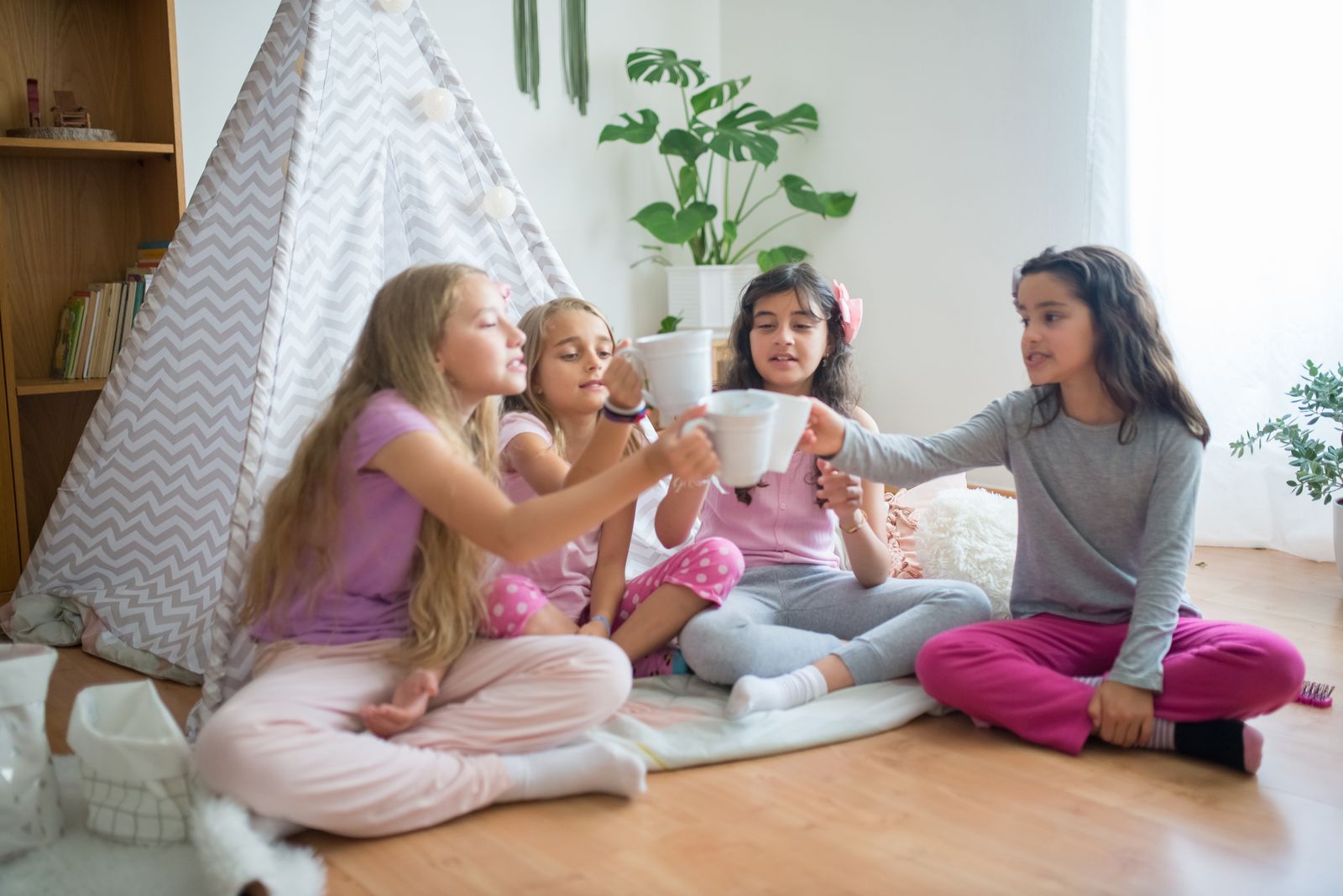
- Play teepees are a cone of fabric over poles that cross at the top. They are taller in the middle and take less floor than a castle, which makes them good for a reading corner or a spot by the bed. See play teepees.
- Play tunnels are tubes of fabric on a wire frame, long enough to crawl through, that fold flat into a disc. The tunnels here come in 3m, 5m and 8m lengths, and some sets join a tunnel to a play tent. See play tunnels.
- Ball pits and playpens are low walled spaces for a baby or toddler to sit and play in, with mesh, padded or PVC walls. Many are sold without balls. See ball pit tents.
- Bed tents and quiet dens: a pop-up castle bed tent that sits on a single bed or a bunk, a dome tent that fits over a bed or sits on the floor, and a blackout sensory tent with a fibre optic light mat for calm, quiet time.
- Inflatable and water play: an inflatable play tent blown up by a box fan, a kids' beach tent with a mini pool, and an inflatable paddling pool tent for the garden.
Every one of them is in children's tents, and the whole department is kids' tents. None of them gives a waterproof rating, and none is made for a night outdoors.
Choose by the child. A child who hides away to read suits a teepee or a castle; one who needs to burn off energy, a tunnel; a baby or toddler, a ball pool or playpen where you can see them.
Safety first: what to look for on the label and the box
A play tent made for children is a toy, and toys sold in Great Britain have their own law: the Toys (Safety) Regulations 2011. The government's guidance, from the Office for Product Safety and Standards on GOV.UK, says they cover toys designed or intended for play by children under 14. Here is what that means you should find, and what the British Toy and Hobby Association (BTHA) tells parents to check.
The mark
Look for a UKCA or CE mark on the toy, its label or its box. Either is accepted in Great Britain; GOV.UK says the recognition of the CE mark there has been extended indefinitely. The mark is the maker saying the toy meets the safety rules. The BTHA advises looking for it, but warns that it is not proof on its own: in the toys it had tested in 2026, bought from third-party sellers on online marketplaces, 65% of those found unsafe carried a CE or UKCA mark. You may also see the Lion Mark, which only the BTHA's own members use.
Behind the mark there should be a test. The BTHA's members must make their toys to the EN 71 series of toy safety standards, and the BTHA describes Part 1, EN 71-1, as covering a toy's mechanical and physical properties, such as small parts and cord lengths; toys with electrical parts have their own standard, EN 62115.
The name and address
The toy, its packaging or a document with it must say what the toy is, with a type, batch or model number, and who made it, and for an imported toy must give the importer's name and postal address. The BTHA tells parents to check there is a UK address and that the packaging looks genuine. Keep the box or leaflet: it is the record of who to contact.
The warnings and the age
Under the Regulations, warnings are in English, start with the word "Warning", and where it matters give the youngest or oldest age the toy suits and whether it needs an adult watching. A toy that might be dangerous for a child under three carries "Not suitable for children under 36 months", or the same in words or a symbol, with a short note of the hazard, such as small parts. The BTHA says toys with small parts must be aimed at children of three and over. So if the box carries that warning, the tent is not for a baby or a toddler, whatever the photo shows.
Checks when it arrives
The BTHA's list for a new toy is a good one for a play tent. Look it over for faults and detachable small parts, exposed stuffing, long cords, and loose or accessible batteries or magnets. Check the age and the warnings, and that the box matches what you ordered. If you think a toy is unsafe, the BTHA advises reporting it to the seller and to your local trading standards office.
Small parts, cords and loops
The Regulations say toys for children under three, and their parts, must be too big to be swallowed or breathed in, and that no toy should risk strangling a child. For a play tent, the things to look at are the extras: toggles and buttons on curtains, bunting, balls, and the cords that tie back the door. Keep loose decorations away from babies and toddlers, keep tie-back cords short and tied up, and do not hang anything inside the tent that a small child could get round their neck.
Lights in and around a play tent
Some castles here come with a string of lights or a lamp, and a string of star lights is sold for children's rooms. Three things matter.
- Battery covers. The Office for Product Safety and Standards warns that a swallowed button battery can badly injure or kill a child, and advises checking for any battery compartment not secured by a screw and keeping such items out of reach. One small light here, the LED atmosphere rope light, runs on a 3V button cell. If a child swallows a battery, take them straight to A&E or call 999, take the packaging with you, and do not let them eat, drink or be sick.
- No mains lights. The Regulations do not allow a toy to be powered at more than 24 volts, so mains fairy lights are not toy lights. Keep them out of a play tent unless the tent's maker says they are made for it.
- No candles or hot lamps. Keep any play tent away from heaters, radiators, lamps and candles.
The door
The Regulations say a toy a child can get into must have a way out the child can open easily from inside. Tie the door back for a small child rather than zipping them in, and stay close to a baby in a playpen and to any child in a blackout or sensory tent. With water, never leave a child alone even for a moment: the paddling pool tent is, in its maker's words, for use under adult supervision in a safe, shallow environment only.
Indoor or garden: fabric, frame and floor
Most of the play tents here say they are for indoors and outdoors. Outdoors means a dry garden or the beach on a fine day. With no waterproof rating, they come in at night and before rain.
Fabric
Polyester is the most common: light, quick to dry and easy to wipe. Thickened Oxford cloth makes a sturdier, more house-like tent, such as the folding tipi castle. Cotton and canvas feel softer and breathe, and the large castle teepees here are thickened cotton or polyester with a cotton-feel lining. Mesh, on ball pools and playpens, lets you see in from across the room. PVC wipes clean and suits ball pits. On the beach, the kids' beach tent here is silver-coated cloth that blocks UV, which gives shade but not complete protection, so keep sun cream and a hat on as well.
Frame
Pop-up tents have a sprung wire frame that opens the moment it leaves the bag. It is quick, but lively, so open and fold them away from faces. The others stand on poles: fibreglass on the dome bed tent, PVC on the teepees, and a metal tube frame on some castles. The inflatable play tent has no frame at all; a box fan, not included, blows it up in about 30 seconds.
Floor
Many play tents, and most teepees, are open at the floor, and the canvas teepee here is sold without its floor mat, so a rug or cushions inside make them cosy. On a wooden or tiled floor, stand a teepee on a rug so its feet cannot slide out when a child leans on the side. In the garden, choose dry, level grass, shake the grass out afterwards, and bring the tent in: a play tent is light, and a gust can tip it or carry it off.
Ages and sizes
Each product here gives its own age guidance where the maker states one, and they vary widely, so read it on the product page and again on the box. These are some of the ages given by the makers of the tents here.
- Babies and toddlers. The mesh ball pool: 6 months and over. The forest green PVC ball pit: 0 to 3 years. The PVC playpen with a storage basket: from birth to 24 months, and on to 5 to 7 years. The large pop-up princess castle: 0 to 3 years.
- From three. The princess ball pool house and the ocean tunnel with its ball pit: 3 years and over. The rainbow crawl tunnel: over 36 months. The dome bed tent: 2 to 3 children aged 3 to 7. The inflatable play tent: 3 to 12.
- School age. The princess den: 4 to 6 years. The khaki playhouse is described for infants, children and juveniles from 0 to 14.
Buy for the age on the label now, not for the age the child will be next year. A tent with small parts or a "not under 36 months" warning waits until the youngest in the house is old enough, or goes in a room the youngest does not use.
Sizes, and how many fit
A play tent always looks smaller in the photo than it is on the bedroom floor. The sizes here run from the 90 by 75cm princess den, through the 112 by 75cm ice cream car and the 120 by 100cm khaki playhouse, to a castle 105 by 120cm and 128cm high with room for a playdate. The castle teepees are 110 by 130cm and 110 by 123cm, and the canvas teepee comes 1.6m or 1.8m tall. The sensory tent, about 90cm each way, is roomy enough for one or two children; the dome bed tent takes two or three; and the inflatable play tent has room for several children and even a parent. Ball pits run from 80cm to 120cm across, and the PVC playpen from 0.9m to 1.5m.
Setting up and putting away in a small room
Measure first. Mark the tent's size on the floor with a few cushions, and leave room all round it to get in and out and to open the bedroom door. Then think about where it goes.
- Away from heat: radiators, heaters and lamps.
- Away from danger: the top of the stairs and furniture with sharp corners.
- Where you can see in, for a baby or toddler: a mesh playpen in the middle of the living room rather than tucked behind the sofa.
Each kind
- Pop-up tents spring open on their own and fold back into a flat disc with a twist that takes practice, so try it once before the children are watching. Folded, most slide under a bed or behind a wardrobe.
- Teepees stand because their poles lean on each other. The folding tipi castle's maker says it goes up in 3 steps and about 2 to 3 minutes.
- Bed tents must fit the bed. The castle bed tent is 140 by 100 by 80cm and made for single beds and bunks, and opens in about a minute. Measure the mattress, and the space above it, before ordering.
- Tunnels need a clear run. Lay a tunnel out where it will go before the children arrive, with clear space at each end, and send children through one at a time in the same direction. A child in the middle of a long tunnel is out of sight, so stay close.
- The inflatable play tent needs more floor and a box fan running beside it; keep the fan's cable and blades where small hands cannot reach.
To put it away, shake out crumbs and small toys and fold it into its bag. A tent that comes out after school and goes back at bedtime keeps a small room usable.
A child's first real camping tent, and sharing yours
For a night outside, a child needs a real tent, not a play tent. The first night out is often in the garden, which is a good time to practise putting the tent up and to find out whether a child really wants to sleep outside before you take them further.
A tent of their own
The number on a camping tent's label is the number of sleeping mats that fit side by side, with nothing else inside, as tent sizes explained sets out. So a 1-man tent holds one child and their mat, with bags in the porch, and a 2-man tent gives one child room for their bag inside, or two children a tent between them. Pop-up tents spring open from the bag, which children love, but they are light: peg them every time, even in the garden.
Sharing the family tent
Most families start by sharing. Choose a family tent with room to spare: a 5-man or 6-man tent suits a family of four with their bags and somewhere to sit when it rains. Two separate bedrooms let children be settled while the adults sit up in the living area, and a dark bedroom helps small children nap and sleep past sunrise. Family tents: rooms, layouts and awnings explains the layouts, and family tents and two bedroom and living room tents have the tents.
Keeping them safe on the campsite
- Never a stove, a heater or a barbecue inside a tent or a porch, even one that has gone out: carbon monoxide kills. Do the cooking outside, away from the tent.
- Guy lines are hard to see in the dark. Clip-on guy-rope lights make them visible, and glamping lights has a pack of ten.
- Give each child their own battery or rechargeable light, never a candle, and check the battery covers are closed.
On the beach, the small pop-up beach tents give a baby or young child shade on the sand, and one is made for children under three. They give shade, not supervision. Beach tents and sun shelters covers shade for babies and children in full, and beach tents has the tents. For what else to pack for children, see the camping checklist.
Cleaning play tents and ball pit balls
Play tents get dirty fast: snacks, felt tips, muddy knees and the dog. The Regulations require toys for children under three to be made so they can be cleaned, and fabric toys for that age to be washable, so look for the cleaning instructions on the label and follow them.
- Machine washable: the dome bed tent here is polyester and machine washable. Take out the poles first and wash it as its label says.
- Wipe clean: the PVC playpens, the padded ball pit and the polyester ball pool with a basketball hoop all wipe clean with a damp cloth. The large castle teepees are described as easy to clean.
- Everything else: spot-clean with a damp cloth and a little mild soap, and rinse with a clean damp cloth.
Whatever it is made of, dry a play tent fully before folding it away, especially after a day in the garden. Damp fabric folded into a bag goes mouldy, just as a camping tent does; tent care explains why and what to do about it.
Ball pit balls
Balls collect crumbs and germs quickly. Wash them in a sink or bath of warm soapy water, a batch at a time, rinse them in clean water and spread them on a towel to dry fully before they go back in the pit. While you have them out, throw away any that are split, cracked or crushed. The balls sold with some pits here are 4cm and 5.5cm across; if you buy balls separately, check their own age guidance as well as the pit's. Shake out tunnels after the garden, wipe them and let them dry open before folding.
Questions people ask
Can a play tent stay in the garden overnight?
No. None of them gives a waterproof rating, and a light tent can blow away. Bring it in at night and before rain.
Are the balls included with ball pits?
On most, no. The mesh ball pool can come with 50 balls, and some tent and tunnel sets with 100; the product page says.
Is a play tent safe for a baby?
Only one whose age guidance includes babies, such as the mesh ball pool from 6 months, with an adult beside them. If the box says "Not suitable for children under 36 months", it is not for a baby.
Can I put fairy lights in a play tent?
Battery lights with a battery cover a child cannot open, kept out of reach of small children. Not mains lights unless the tent's maker says they are for it, and never a candle.
How do I know a play tent has passed safety tests?
Look for the UKCA or CE mark, the maker's or importer's UK address and the warnings on the toy or its box when it arrives.
Where to go next
- Children's indoor tents, play teepees, play tunnels and ball pit tents.
- All kids' tents.
- Tent sizes explained, for a first camping tent.
- Family tents: rooms, layouts and awnings, for sharing yours.
- The camping checklist, for what to pack for children.
Delivery is included in every price and tracked to your door.