A roof tent turns a car into a camper. It lives on the roof bars, opens in minutes at the end of the drive, and gives you a flat bed off the wet ground wherever you can park. A car awning does a smaller job: a roof off the side or back of the car to sit and keep kit under. This guide covers the kinds of each, whether a roof tent will fit your car, the tents that fix to the back of an SUV or into a pick-up, and what a tent on the roof means for wind, fuel, car parks and ferries.
All of them are in vehicle tents, with each kind in its own range below.
What a roof tent is: soft shell and hard shell
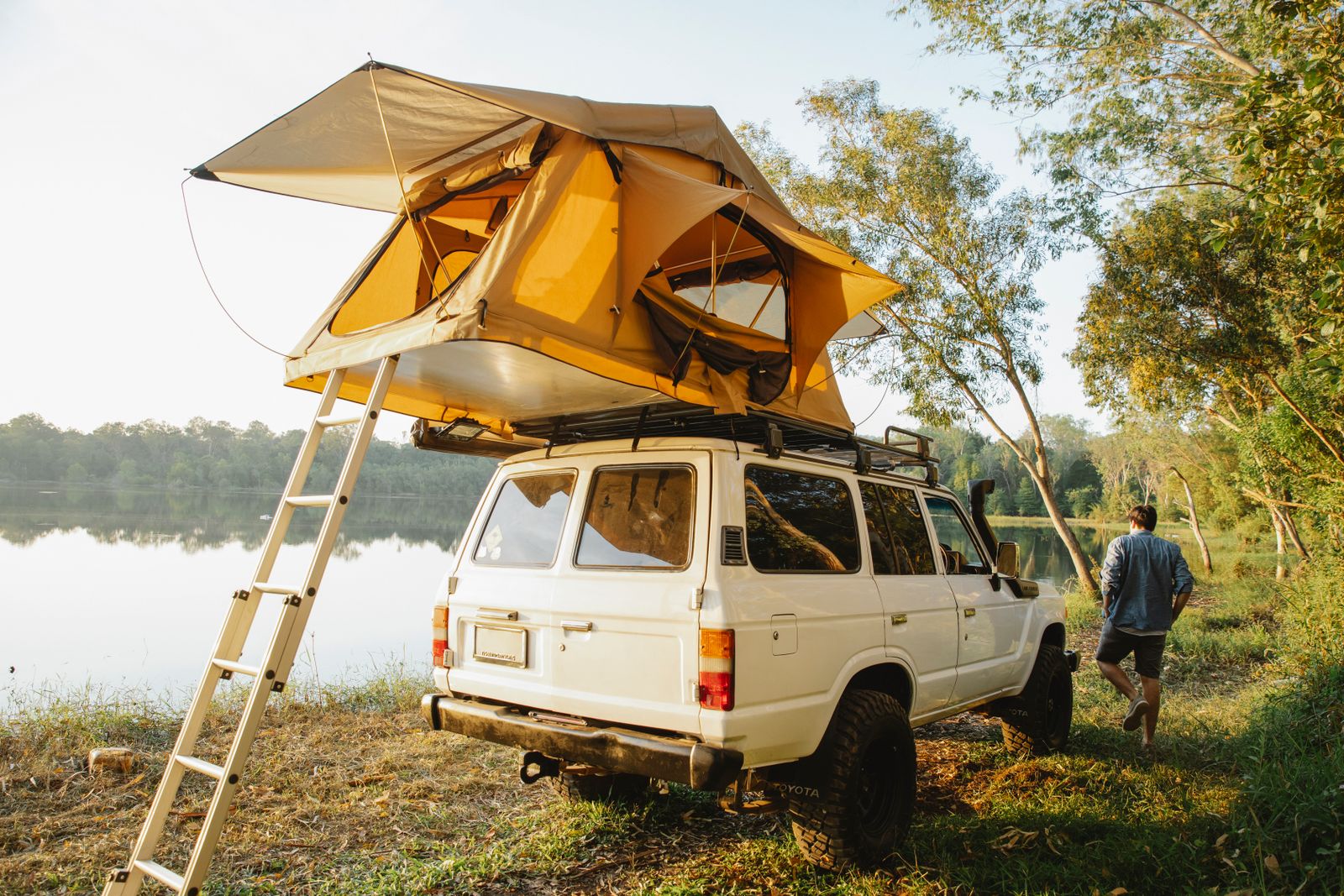
A roof tent fixes to roof bars or a roof rack, never straight onto the roof itself, and travels folded up. At camp it opens on the roof, so you sleep above the ground, away from wet grass, stones and slopes, and the car is your foundation. Roof tents come in two main families.
Soft shell
A soft-shell roof tent is fabric on a folding frame. For travel it folds in half into a low pack with a travel cover over it. At camp it opens out like a book: one half sits on the roof bars, and the other half reaches out past the side or back of the car, held up by the ladder. That gives a lot of floor for the size of the pack, and room for an annex underneath. It takes a few minutes longer to open and close than a hard shell, and the cover has to come off and go back on. The SUV Rooftop Tent here is fabric on an aluminium frame, with a large rainfly that extends at the back, and the inflatable roof tent here stands on air columns blown up with a pump, opening to 220 by 140cm.
Hard shell
A hard-shell roof tent, also called a tent box, has a rigid lid and base of aluminium, ABS plastic or carbon fibre, with the tent folded between them. Undo the latches and gas struts or a hydraulic lift push it open, often in under a minute, and it closes the same way. The shell keeps the fabric out of the rain and road dirt while you drive, and a slim one sits low on the roof. Hard shells are the biggest group in roof tents and tent boxes, in four shapes:
- Pop-up. Shape: the whole lid lifts straight up, so the height is the same from end to end. Example: the Aluminium Hard Shell Rooftop Tent for 4, 19cm deep closed and 107cm high open.
- Clamshell or wedge. Shape: hinged at one end, tall at the door and low at the feet. Example: the Wedge Hard Shell Roof Tent, which opens on gas struts.
- Side opening. Shape: the lid rises along one side for more headroom. Example: the Fast Setup Hard Shell, 1.4m at its peak, opening in under 60 seconds.
- Triangle. Shape: a sloping shell. Example: the Triangle Aluminium Hard Shell, with a hole ready for a solar panel.
Some lift electrically, such as the Electric Lift 1-2 Person, and a few are made for van roofs: the insulated 4-season carbon fibre pop-up is shaped for vans such as the Mercedes Sprinter.
Which suits you
Choose a hard shell if you move on most days and want camp up and down in a minute. Choose a soft shell if you stay put for a few nights and want more floor or a room underneath. Either way, camp is packed up each time you drive anywhere, even to the shop. To leave a pitch and come back to it, a tent that stands on its own is easier: see the guide to family tents.
Will it fit your car: roof bars, the roof's load limits, moving and parked
This is the check that matters most. A roof tent is heavy: one UK maker lists its own roof tents at between about 33kg and 72kg. The car, the roof bars and the tent all have to be up to it.
Dynamic load: the figure for driving
Every car has a roof load limit, given in the handbook, usually under the technical data, and often on the maker's website. This is the dynamic load: the weight the roof may carry while you are driving, through braking, corners and bumps. The RAC and the Caravan and Motorhome Club both point out that it includes the roof bars or rack as well as whatever sits on them. So the tent plus its bars must come in at or under the car's figure.
Static load: the figure for parking
The static load is what the roof will hold when the car is parked. It is higher, because nothing is being thrown about, and it is the one that matters when you and your sleeping bags are inside the tent. Many car makers do not publish a static figure at all, and the Caravan and Motorhome Club notes there is no standard test for it, so never guess one. Everyone inside counts towards it, along with the tent. The weights in the product descriptions here, such as the inflatable tent's 200kg capacity and the wedge tent floor's 215kg rating, are what the tent will carry inside, not what your roof will.
The roof bars have a rating too
Roof bars and racks have their own load rating in their instructions, and the lowest figure in the chain is the one that counts. Thule, the rack maker, says the rack must suit your type of roof and carry rack and tent together, and that with a glass or panoramic roof you should check with the car maker that it can take a roof tent.
The shape of the roof
Several makers here ask you to check your car's roof against the product picture before you order, because fit varies between models and countries. Measure the roof, and check that a tent opening over the side or back will clear the aerial and the tailgate.
So before you buy: find the dynamic load in the handbook, find the bars' rating, find the tent's own weight, and make sure tent plus bars is under both.
Climbing in: the ladder, the mattress, the annex underneath
The ladder
Most roof tents come with a ladder, usually aluminium and telescopic, so it slides down to the height you need. On a soft shell it also holds up the half of the tent that reaches out past the car. Several tents here include one: the Aluminium Hard Shell for 4 to 6 people, the hard shells with a side flap and ladder, and the Automatic Quick Setup tent with its aluminium ladder. The inflatable roof tent's ladder extends up to 2.3m. Stand the foot on firm, level ground at the angle the maker gives, and keep a torch by the door for climbing down at night. Park on level ground, so you are not sleeping on a slope.
The mattress
The bed is part of the appeal: a flat mattress that stays in the tent, often with the bedding folded inside when it closes. Check what each tent includes. The Wedge Hard Shell comes with 50mm high-density foam mattress pads with washable covers, and the inflatable tent has an air base 220 by 140cm and 15cm deep. Some descriptions do not mention a mattress, so check before you order.
Condensation forms inside any tent, more so in a closed shell on a cold night, and a damp mattress is hard to dry. Open the vents: the Wedge Hard Shell has adjustable venting to cut condensation in cold weather, and the Fast Setup tent has bug mesh on its openings so they can be left open.
The annex underneath
An annex is a room of fabric that hangs from the overhanging half of a soft-shell roof tent down to the ground, making a private space under the bed to change, keep kit or put a camp bed. Thule describes it as the usual reason to choose a soft shell. Annexes are made for one maker's tent, so check that one is sold for the tent you choose. Here the nearest things are a side flap on some hard shells, which gives extra covered space, the 2-Person Clamshell's optional awning and shower tent, and the ensuite shower tents made to fit beside a camper trailer or a hard-shell roof tent.
Car awnings: side, 270 degree and tailgate
A car awning is a roof without a room: shade and rain cover beside or behind the car, put up in minutes. Every kind is in car awnings.
Side awnings
A side awning rolls out from a case fixed to the roof rack along one side of the car, on legs that drop to the ground. The MOBI GARDEN side awning here opens to 340 by 230cm and 180cm high and weighs about 3.9kg. Simpler versions are a sheet that fixes to the roof rails: the butterfly awning needs no poles, and the bat-shaped one gives up to 8 square metres of shade. The Multi-Mode awning, 4 by 2.5m, works as a side awning, a boot tent or a tarp on its own, and is rated PU 8000mm with taped seams.
180 and 270 degree awnings
These swing round from the roof rack in an arc. A 180 degree awning covers the side of the car; the one here comes with a 2m or 2.5m radius and is free-standing, so it does not rely only on the car for support. A 270 degree awning wraps round the side and the back, so you can open the boot under cover. The ones here come in 190cm and 230cm sizes, one with a 5000mm fabric, six telescopic support rods and a ratchet to keep it tight, and one with an optional change room, mesh room and extension panel. A side room, a wall annex for 270 awnings with a 2m or 2.5m radius, closes the space in.
Tailgate awnings
A tailgate or rear awning stretches from the open boot of an SUV or estate, on two poles and pegged out. The SUV Rear Awning Tent here folds to 44 by 15 by 15cm.
Caravans and motorhomes
Awnings that roll out from the side of a caravan or motorhome, porch awnings, privacy screens and replacement fabric are in caravan and motorhome awnings. Measure your van and your awning first, because most are sold by length.
Ratings, shade and cooking
For rain, the awnings here are rated from PU2000mm to PU 8000mm, the hydrostatic head tested to ISO 811, and the guide to waterproof ratings explains the numbers. For sun, several give UPF50+, and silver or black coatings keep the space underneath cooler. Keep a stove or barbecue out in the open, clear of the awning fabric and the car, and never under an awning joined to a tent.
SUV and tailgate tents, and truck-bed tents
Tailgate tents
A tailgate tent joins on to the open boot of an SUV, estate, hatchback or van, so the car and the tent become one space. You can sleep in the back of the car with the tent as a porch, or sleep in the tent and keep kit in the boot. There are several kinds in SUV and tailgate tents:
- Car Tail Tent. Size: 480 by 220cm, 195cm high, for 3 to 4 people. Weight: 6kg. Rating: PU3000mm.
- Dual-Use SUV Rear Tent. Size: 210 by 300cm, 185cm high. Weight: about 6kg. It also stands on its own, so you can drive off and leave it pitched.
- Car Tailgate Awning Tent, for a 4x4, trailer or pick-up. Three sizes, 6.1kg to 6.8kg, with a flysheet over an inner tent.
- SUV Tailgate Tent for Rear Car Camping. Fits small and medium SUVs and vans whose tailgate lifts up. Weight: about 3.15kg. Rating: 2,000mm.
The join between tent and car is where wind and rain get in, so look at how each one seals: elastic edges that fit the car body, straps and hooks round the tailgate, or a three-layer door. Compare the sizes with your own car, tailgate open, before you order. One here is made only for the VW T5 and T6 Transporter: a shower and changing tent for the rear door. For privacy on a beach or at a car park, the changing tents hang from a tailgate or the rear window on suction cups.
Never run the engine to keep warm with a tent on the back of the car. The exhaust is right underneath, and exhaust fumes carry carbon monoxide, which kills.
Truck-bed tents
A pick-up's load bed makes a raised, flat floor to sleep on. A soft truck-bed tent pitches inside the bed on its own poles and straps to the truck: the two-person one here is 210 by 170cm and 170cm high, fits 5.5 to 6.5ft beds, is rated over 4,000mm and weighs about 4.8kg. A hard shell fits over the bed and opens up: the ABS one here is made for beds such as the Ford Ranger, RAM, Chevy Silverado and Nissan Frontier, needs no drilling and locks at the tailgate. Measure the bed from the back of the cab to the closed tailgate, the width between the wheel arches and the height of the sides before you choose, and put a mat down, because the ribs of a bare bed are hard to sleep on. See truck bed tents, which also lists the roof tents and awnings made to fit pick-ups.
Tailgate and truck-bed tents put no load on the roof, so they suit a car that cannot take a roof tent. The guide to air tents and pole tents covers the frames they stand on.
Wind, rain and driving with it on
Wind at camp
A roof tent sits higher than a ground tent, so it catches more wind. Roof tent makers commonly advise parking so the narrowest side of the tent faces the wind, and in strong wind taking down porch or canopy poles and tying back loose fabric. Read your tent's instructions for any wind limit. Shelter from a hedge or bank helps, but avoid parking under big trees.
Awnings are large sails held at one edge. Peg the legs and guy them out every time, even on a still afternoon, and wind the awning in before a strong wind arrives, or before you go to bed if the forecast is uncertain. Take spare guy lines and longer tent pegs than the ones in the box if you camp on soft ground.
Rain
A roof tent stays above the puddles. Park with the door away from the rain and use any canopy over the door. The flysheets here are rated from about 2,000mm to 5,000mm. If you pack it wet, open it at home within a day or two and dry it fully, mattress included, or mould will start in the folds.
Driving with it on
The Highway Code, rule 98, says you must not overload your vehicle, and that you must secure your load so it does not stick out dangerously. The RAC adds that a roof load can change how a car handles, so take corners, braking and crosswinds more gently. A closed hard shell is low and smooth; the Fast Setup tent's maker describes its slim shell as cutting wind drag and road noise. Before every journey, check the tent is closed and latched, the ladder stowed and the fixings tight, and look again after the first few miles. Never drive with an awning out.
Fuel, height barriers and ferries: living with it on the car
Fuel
Anything on the roof adds drag. The Vehicle Certification Agency, the government body that tests cars' fuel use, says a roof box typically adds around 22% to fuel consumption at 62mph and around 39% at 75mph, and that even empty roof bars can add around 7% at motorway speeds. Those figures are for a roof box and bars, not a roof tent, but a roof tent is a bulky load of the same kind, so expect to use more fuel or battery, most of all at motorway speed. If the tent stays on all year, so does the extra cost.
Height barriers, car parks and garages
With a tent on the roof, the car is taller, and the RAC warns that this can stop you entering car parks and other low-clearance places. Measure the car's full height with the tent fitted and closed, and keep the figure on a note on the dashboard. Many multi-storey car parks, height barriers at country parks and beaches, and your own garage door will be too low.
Ferries and tunnels
Ferry companies price cars by size, and height matters. Irish Ferries, for example, sets its car fares in height bands measured including anything on the roof, and says that declaring the wrong size can lead to extra charges or being refused at boarding. Other companies have their own bands. When you book, give the height with the tent fitted, and check the company's rules on roof loads before you travel.
Questions people ask
Can my car take a roof tent?
Look up the dynamic roof load in the handbook, the rating of your roof bars, and the tent's own weight. The tent plus its bars must be under both figures. If the car has a glass roof, check with the car maker first. If the numbers do not work, a tailgate tent or an awning puts no weight on the roof.
How many people can sleep in a roof tent?
The ones here are made for one or two, two or three, three or four, and four to six. Everyone inside counts towards the roof's parked load, along with the tent and bedding.
Can I drive off and leave my camp pitched?
Not with a roof tent: it goes wherever the car goes. The Dual-Use SUV Rear Tent stands on its own as a shelter, and the 180 degree awning is free-standing, but it still fixes to the car, so it must be wound in before you drive.
Do roof tents work in winter?
Some are made for it. The 4-season carbon fibre pop-up is insulated, and the Wedge Hard Shell has vents to cut condensation in cold weather. Never use a heater, stove or barbecue inside a roof tent or a tailgate tent, and never run the engine for heat.
Where to go next
- To sleep on the roof: roof tents and tent boxes.
- For shade and shelter beside the car: car awnings, and for caravans and motorhomes, caravan and motorhome awnings.
- For the back of the car or a pick-up: SUV and tailgate tents and truck bed tents.
- Everything together: vehicle tents.
- Read on: family tents: rooms, layouts and awnings, air tents or pole tents and tent waterproof ratings explained.
Delivery is included in every price and tracked to your door.